

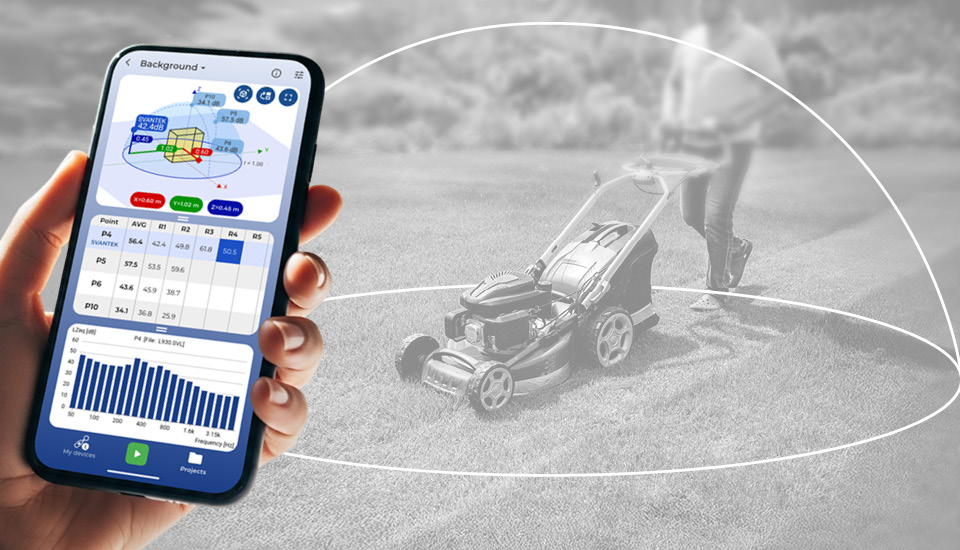
In acoustic engineering, the Sound Power Level (LW) is the fundamental metric used to describe the total acoustic energy radiated by a source per unit of time. Unlike the Sound Pressure Level (Lp), which is a scalar value that fluctuates based on the measurement distance, directivity, and the surrounding acoustic environment (reflections/absorption), the Sound Power Level is an intrinsic property of the machine. This makes the essential parameter for international noise emissions certification, regulatory compliance, and the objective comparison of different devices.
Sound power (W) is defined as the total acoustic energy radiated by a source per unit of time, measured in Watts. While sound power represents the absolute energy output, the industry standard for reporting this value is the Sound Power Level (LW), expressed in decibels (dB) relative to a reference level of
Watts (1 pW). Unlike sound pressure, which fluctuates based on distance, orientation, and room acoustics, sound power is an intrinsic property of the source. This independence makes it the definitive metric for noise emission labeling, international certification, and the objective comparison of machinery performance across different environments.
Determining the sound power level is technically more demanding than measuring sound pressure, as it requires characterizing the source’s radiation across a complete enclosed measurement surface. According to international standards such as ISO 3744 and ISO 9614, the sound power level serves as the “acoustic cause,” while the resulting sound pressure level (Lp) at a specific location is the “effect.” By establishing the LW, engineers can accurately predict the at any given distance or within any acoustic environment, providing the foundational data necessary for environmental noise modeling and regulatory compliance.
Because sound power is an intrinsic characteristic of a noise source—independent of measurement distance or room acoustics—it serves as the definitive acoustic parameter for a given piece of machinery. This data is the foundation for the CE marking and international certification of industrial and consumer equipment, facilitating objective comparisons between different models. Under the EU Outdoor Noise Directive (2000/14/EC) and various ISO 3740 series standards, sound power levels are used to verify that equipment meets statutory noise limits before it can be placed on the market.
Measuring the Sound Power Level (LW) is also essential for evaluating the real-world effectiveness of noise mitigation strategies. By comparing LW before and after modifications—such as the installation of acoustic enclosures or the redesign of internal components—engineers can quantify the absolute reduction in noise emission at the source. Furthermore, knowing the sound power level allows for accurate occupational safety assessments and the creation of predictive noise maps, ensuring that the integration of new machinery into a production facility does not exceed permissible noise exposure limits for workers.
The ISO 3740:2019 standard serves as the primary international guide for the determination of sound power levels of noise sources, providing a systematic framework for selecting the most appropriate basic standards. By unifying measurement methodologies across countries adhering to ISO and CEN (European) standards, this series ensures a transparent global market and allows for the objective comparison of machinery from different manufacturers. These protocols are essential for regulatory compliance, such as CE marking and the EU Machinery Directive, ensuring that noise emission data is reliable and consistent regardless of the testing location.
The comprehensive series, ranging from ISO 3741 to ISO 3747, defines various measurement methods tailored to specific acoustic environments and machine types. For instance, ISO 3741 and ISO 3745 specify high-precision laboratory methods in reverberation rooms or anechoic chambers (Precision Class 1), while ISO 3744 and ISO 3746 provide engineering and survey methods for hemi-anechoic or outdoor spaces (Class 2 and 3). This graded approach allows engineers to account for background noise and environmental reflections, ensuring that the final Sound Power Level (LW)
) is calculated with a known degree of uncertainty.
In acoustic engineering, the Sound Power Level (LW) of a device is determined using one of two primary international methodologies: the Sound Pressure Method or the Sound Intensity Method. The selection depends on the acoustic environment, the required accuracy grade (Precision, Engineering, or Survey), and the physical portability of the equipment being tested.
The Sound Pressure Method, governed by the ISO 3741 to ISO 3747 series, calculates sound power by measuring sound pressure levels (Lp) over a defined surface in controlled environments, such as anechoic chambers or reverberation rooms. In contrast, the Sound Intensity Method, defined by ISO 9614-1 (discrete points) and ISO 9614-2 (scanning), measures the directional energy flow (W/m2). The intensity method is particularly used for in-situ measurements on factory floors because it can isolate the machine’s noise from high levels of steady background noise that would otherwise invalidate pressure-based measurements.
It is essential to distinguish between the Sound Pressure Method (ISO 3741–3747) and the Sound Intensity Method (ISO 9614-1/2). While standard pressure methods generally require Class 1 (Type 1) instrumentation for high-precision results, intensity-based standards (IEC 61043) also mandate high-grade equipment but allow for greater flexibility in in-situ environments where background noise is high.
Sound Pressure Methods (ISO 3741–3747)
These standards determine sound power by measuring sound pressure over a defined surface, with the required environment and noise type varying by the specific standard:
Sound Intensity Methods (ISO 9614-1/2)
These methods utilize the directional energy flow to isolate the source from the background, making them ideal for complex field conditions:
To select the optimal sound power determination method, acoustic engineers follow the framework provided by ISO 3740:2019, which outlines eight critical criteria for choosing between pressure-based and intensity-based standards. The primary goal is to balance the accuracy class (Precision, Engineering, or Survey) with the practical limitations of the testing site and the physical characteristics of the machine.
According to ISO 3740, the selection process is governed by the following factors:
For a streamlined decision-making process, Annex D of ISO 3740 provides a standardized selection flowchart. This logic tree guides the user to the most appropriate ISO standard based on the answers to these eight factors, ensuring that the final data is technically valid and compliant with international CE marking or Machinery Directive requirements.
The selection of a test environment is a critical technical requirement under ISO 3740, as the physical space directly determines the achievable accuracy grade (Precision, Engineering, or Survey). International standards categorize these environments based on their ability to control reflections and background noise, ensuring the resulting Sound Power Level (LW) is reproducible and compliant with global certification standards.
The classification of these environments is strictly defined by the intended measurement methodology:

To determine Sound Power Level (LW), the measurement process must strictly adhere to the standardized protocols defined in the ISO 3740 series. The reliability of the resulting data depends on the rigorous control of operating conditions, environmental interference, and instrumentation accuracy.
1. Source Operation and Repeatability
In accordance with ISO 3744 and the EU Machinery Directive, the noise source must be tested under repeatable and representative conditions, typically focusing on the “worst-case” or loudest operational mode encountered in typical use. For many industrial machines, this requires a stabilized thermal state and a specific load profile. Consistency in these parameters is essential for the data to be valid for CE marking, product labeling, or comparative benchmarking between different manufacturers.
2. Environmental and Equipment Integrity
The measurement methodology must account for two critical external factors: background noise (K1 correction) and environmental reflections (K2 correction).
3. Spatial Sampling and Methodology
The number and location of measurement points are determined by the chosen ISO standard and the dimensions of the measurement surface (the “envelope”) surrounding the machine. For the Sound Pressure Method, points are usually distributed across a hemispherical or parallelepiped surface. For the Sound Intensity Method (ISO 9614), a scanning or point-to-point grid is used. This comprehensive approach ensures that the total acoustic energy radiating in all directions is captured, providing a single, objective value that defines the machine’s “acoustic cause” regardless of the testing location.
The Sound Pressure Method—governed by the ISO 3740 series (specifically ISO 3744 and ISO 3745)—is the most widely utilized approach for determining Sound Power Levels (LW) due to its standardized procedures and high repeatability. The methodology requires defining a virtual measurement surface—typically a hemisphere or a parallelepiped (cuboid)—that completely encloses the sound source. A grid of discrete measurement points is then established across this surface to capture the average sound pressure level (Lp), which is mathematically integrated over the total surface area to calculate the source’s absolute acoustic energy.
While technically simpler than intensity-based methods, the accuracy of the Sound Pressure Method is highly dependent on the acoustic environment. It is most effective in controlled settings such as anechoic or hemi-anechoic chambers, which provide the “free-field” conditions necessary to prevent measurement errors caused by sound reflections. To ensure international data defensibility, engineers must apply specific environmental corrections (K2) to account for any residual reflections and background noise corrections (K1) to ensure the ambient noise floor does not artificially inflate the source’s reported power level.
The Sound Intensity Method—governed by ISO 9614-1 and ISO 9614-2—is the primary technique for determining Sound Power Levels (LW) in complex, real-world environments. This method utilizes specialized intensity probes consisting of a phase-matched microphone pair to measure both sound pressure and the particle velocity of the air. By calculating the cross-spectrum of these two signals, the probe determines the sound intensity vector, which represents the directional flow of acoustic energy (W/m2). This vector approach allows engineers to isolate the energy radiating specifically from the target source while mathematically rejecting noise from external sources, provided those sources are outside the defined measurement volume.
The principal advantage of the intensity method is its high resistance to elevated background noise and reverberation, making it the standard for in-situ measurements on active production floors where transporting machinery to an anechoic chamber is impossible. However, the process is technically demanding; it requires Class 1 (Type 1) instrumentation that complies with IEC 61672-1 and IEC 61043 standards. The equipment is significantly more complex than standard pressure meters, requiring rigorous phase calibration and a time-intensive measurement process—either through a discrete point-by-point grid or a continuous scanning motion—to ensure the Pressure-Intensity (FpI) index remains within the limits required for a valid assessment.
Sound power level (LW) measurements are the primary technical metric for quantifying the absolute effectiveness of noise mitigation strategies. By determining the LW before and after an intervention—while maintaining identical source operating modes and environmental conditions—engineers can calculate the precise insertion loss of the treatment. For high-fidelity assessments, octave-band or one-third octave-band analysis is essential, as most reduction methods, such as acoustic enclosures or silencers, exhibit frequency-dependent performance. To ensure results are statistically significant, the measured reduction must exceed the measurement uncertainty associated with the chosen ISO 3740 series method; therefore, selecting a Class 1 (Precision) or Class 2 (Engineering) method is critical for identifying subtle but important improvements in the machine’s acoustic output.
Sound Power Level of machinery serves as the fundamental input for predictive noise mapping and occupational safety assessments. By using
data in conjunction with standardized propagation models—such as ISO 9613-2—engineers can accurately estimate the resulting Sound Pressure Levels (Lp) at specific worker locations. These simulations allow for the identification of “acoustic hotspots” and the ranking of noise sources by their contribution to the total 8-hour Time-Weighted Average (TWA), ensuring that the facility complies with international exposure limits set by OSHA, HSE, or EU Directive 2003/10/EC.
Furthermore, these predictive models enable management to optimize the workplace layout and administrative controls before equipment is even installed. By simulating different operational scenarios, safety officers can determine the most effective noise abatement strategies—such as acoustic partitioning or specialized scheduling—to minimize the number of employees within high-decibel zones. This data-driven approach is essential for designing a “hearing conservation program” that prioritizes engineering solutions over secondary measures like personal protective equipment (PPE).
The ISO 3746 standard (and its national adoption, PN-EN ISO 3746) provides the international requirements for the Survey Method (Accuracy Class 3) to determine the Sound Power Level of a noise source. This methodology utilizes sound pressure measurements taken over an enveloping measurement surface—typically a hemisphere or parallelepiped—located over a reflecting plane. As the least stringent of the ISO 3740 series, it is designed for in-situ assessments in environments where background noise or room reflections cannot be strictly controlled, such as active production floors or outdoor sites. While it allows for a simplified measurement setup, it carries a higher degree of measurement uncertainty compared to Engineering (Class 2) or Precision (Class 1) laboratory methods.
As an Accuracy Class 3 (Survey) method, ISO 3746 provides the most flexible framework within the ISO 3740 series for determining sound power levels. It is specifically designed for in-situ assessments where specialized environments like anechoic chambers are unavailable; measurements can be conducted indoors or outdoors, provided the source is located on or near at least one reflecting plane. While the standard permits the evaluation of nearly any noise character—including steady, fluctuating, or impulsive sounds—it still mandates the use of Class 1 (Type 1) instrumentation to ensure data integrity.
The primary technical constraints are limited to the Background Noise (K1) and Environmental (K2) corrections, which must remain within defined thresholds to ensure the resulting Sound Power Level (LW) remains a valid, albeit approximate, representation of the source’s emissions.
The environmental correction (K2) is a technical factor applied to the mean sound pressure level to account for the influence of room reflections and absorption. According to ISO 3746 (and PN-EN ISO 3746), this correction is calculated using the formula
K2A= 10 LG[1+4 S/A]DB
where S represents the area of the measurement surface and is the equivalent sound-absorbing area of the test room. To ensure the validity of a Survey Grade (Class 3) measurement, the K2A value must not exceed 7 dB; if this threshold is surpassed, the acoustic environment is considered too reverberant to provide a reliable sound power level under this standard.
The background noise correction (K1) is a technical adjustment applied to the measured sound pressure level to isolate the source’s emissions from ambient noise. According to ISO 3746 (and PN-EN ISO 3746), this correction is determined by calculating the difference between the sound pressure level with the source operating and the background level with the source deactivated. If the difference is greater than 10 dB, the background influence is considered negligible, and the
correction is 0 dB. For differences between 3 dB and 10 dB, the correction is calculated using the logarithmic formula
K1A= -10lg(1-10^(-0.1△L_PA)) dB
If the difference is less than 3 dB, the signal-to-noise ratio is too low for a standard assessment; the correction is capped at 3 dB, and this must be explicitly documented in the report as an “upper limit” of the source’s true sound power.
To determine the Sound Power Level in accordance with ISO 3746, it is necessary to measure the energy-averaged sound pressure levels across a virtual measurement surface (S) that completely encloses the source. The dimensions of this surface are derived from a reference box—the smallest possible rectangular parallelepiped that contains the noise source—while disregarding minor protruding elements that do not contribute significantly to the acoustic emission. Depending on the installation and the reflecting planes present, the measurement surface is typically defined as either a hemisphere or a parallelepiped (cuboid).
The final calculation begins by determining the surface sound pressure level (LpA), which is the time-averaged value corrected by the background noise (K1) and environmental (K2) factors. The Sound Power Level is then calculated using the international standard formula:
LW=LpA + 10log(S/S0)
, where
S is the total area of the measurement surface and
is the reference area of 1 m2. To ensure technical validity for an international audience, the final report must include an uncertainty estimate (U), with specific guidance provided in Annex D of the standard to account for variations in the acoustic field and measurement geometry.
The measurement microphones must be oriented perpendicular (normal) to the virtual measurement surface to accurately capture the radiating sound pressure. Following ISO 3746 (and PN-EN ISO 3746), the specific grid coordinates for these microphones are determined by the geometry of the chosen hemispherical or parallelepiped (cuboid) surface. Technical protocols in Annex C further distinguish these microphone arrays based on the source’s proximity to reflecting planes—such as a floor, a wall, or a corner—ensuring that the spatial sampling accounts for acoustic reflections from two or three adjacent surfaces. This standardized placement is critical for calculating a statistically valid energy-averaged sound pressure level across the entire measurement envelope.
In accordance with ISO 3746 (and PN-EN ISO 3746), the standard frequency range for assessing sound power levels covers the octave bands with center frequencies from 125 Hz to 8,000 Hz. While the primary reported value is typically the A-weighted sound power level (LWA), comprehensive technical assessments require frequency-dependent analysis to accurately characterize the noise source.
If measurements are conducted in octave bands, the background noise correction (K1) and the environmental correction (K2) must be calculated and applied individually for each band, as ambient noise and room absorption vary significantly with frequency. This frequency-specific approach ensures that the final A-weighted total is mathematically grounded and reflects the true spectral characteristics of the equipment.
The Sound Power Level measurement method defined in ISO 3746 is classified as a Survey Method (Accuracy Class 3), offering greater flexibility but lower precision than laboratory-grade “Precision” or “Engineering” methods. Despite its higher measurement uncertainty, this standard is widely adopted in industrial settings due to its simplified implementation and its ability to characterize equipment in-situ under actual operating conditions. Because it relies on well-established sound pressure level (Lp) measurement techniques familiar to industry experts, it serves as a practical tool for the rapid assessment and regulatory screening of machinery where specialized acoustic test chambers are unavailable.
An authorized svantek consultant will assist you with noise and vibration measurements.