

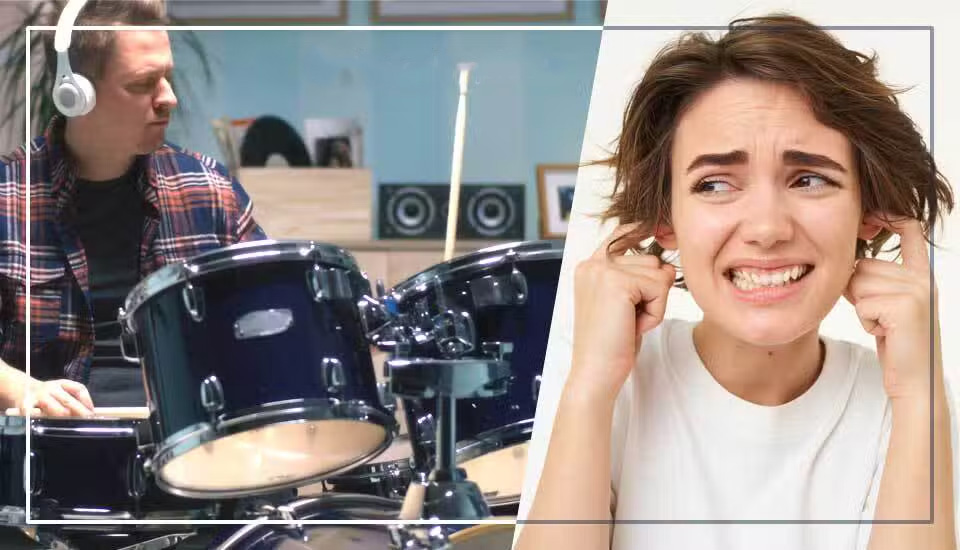
Neighbor noise in apartment buildings consists of unwanted sound energy that travels from one dwelling unit to another through shared structures or common air paths. This phenomenon encompasses airborne noise, such as loud conversations or music, and structure-borne noise, which includes vibrations from footsteps (impact noise) or rattling pipes. Most buildings transmit these sounds because solid materials like concrete and wood conduct energy, while gaps around doors or shared ventilation ducts provide direct paths for sound waves to bypass insulation. Identifying the specific source and level of the noise allows occupants to demand structural repairs, justify rent reductions in legal disputes, or implement targeted soundproofing strategies to restore their right to a peaceful living environment.
Acoustic Source Differentiation is Critical: Professional Acoustic Source Identification is the first step in resolution, as it distinguishes between behavioral human activity and mechanical infrastructure failures. This classification determines whether a resident should pursue a legal remedy for a nuisance or an engineering fix for structural defects.
Health Risks Mandate Compliance: Chronic exposure to neighbor noise triggers severe physiological responses, including cardiovascular stress and sleep deprivation. Because these conditions compromise long-term human health, maintaining acoustic standards is a matter of medical necessity and fundamental habitability rather than mere convenience.
Physical Pathways Dictate Solutions: Understanding the medium of propagation—whether airborne or structure-borne—is essential for selecting effective mitigation. Engineers use decoupling to break vibration paths and high-density materials to block airborne sounds that bypass walls through indirect flanking paths.
Professional Metrics Ensure Legal Standing: Standardized ratings like STC (Sound Transmission Class) and IIC (Impact Insulation Class) provide the objective data needed for court or insurance claims. Utilizing Class 1 sound level meters and accredited laboratories ensures that measurements are technically defensible and meet international standards.
Neighbor noise originates from a combination of human activity and mechanical operations within the building’s infrastructure. Residents generate airborne sounds when they play music, use televisions, or engage in loud conversations, which send sound waves directly through the air. Occupants also produce impact noise when they walk across hard floors, move heavy furniture, or drop objects, which creates vibrations in the floor-ceiling assembly. Additionally, the building’s own systems, such as clattering plumbing pipes, humming HVAC units, and cycling elevator motors, contribute to the overall acoustic load within a shared living space. Understanding these specific sources is essential because different types of noise require distinct technical solutions for mitigation.
The physics of sound propagation defines how acoustic energy moves from a source to a receiver, providing the fundamental baseline for all professional building assessments. Occupants experience airborne transmission when sound waves travel through the atmosphere and penetrate walls or floor assemblies, often resulting in complaints regarding insufficient partition mass or a lack of acoustic privacy.
In contrast, structure-borne transmission occurs when energy travels through the solid building skeleton—such as concrete slabs or steel beams—enabling vibrations from one floor to be heard clearly several levels away. Impact noise represents a critical sub-type of structure-borne sound caused by direct physical contact, such as footsteps or falling objects, and serves as the primary metric for determining habitability in multi-family dwellings.
By identifying whether sound is moving through the air or the building’s physical frame, engineers can select the correct mitigation strategy, such as sealing air gaps or “decoupling” structural components to break the vibration path. Acoustic professionals further categorize these sounds to evaluate the specific performance of building elements like floor-ceiling assemblies and partition walls.
Acoustic Source Identification allows professionals to distinguish between behavioral human activity and the mechanical operations of building infrastructure. This distinction is critical because airborne sounds like voices or music require different legal and technical responses than mechanical noise from elevators, HVAC systems, or clattering plumbing. By categorizing the frequency range of these disturbances, technicians can determine if a “thumping” low-frequency bass or a high-pitched mechanical squeal is the primary nuisance. High-frequency sounds are typically easier to block with standard insulation, whereas low-frequency vibrations often require advanced mass-based solutions or structural modifications to the building’s core.
Technicians also investigate flanking paths, which are indirect routes that allow sound to bypass primary partition walls through shared ventilation ducts, floor gaps, or electrical outlets. These “acoustic leaks” explain why a high-quality wall may still fail to provide privacy if the medium of propagation finds a secondary air or structure-borne path. Identifying these specific pathways is essential to pinpoint whether a noise issue stems from neighbor negligence or a fundamental architectural defect. Once the source and path are confirmed, property managers can implement targeted engineering solutions to seal gaps or dampen vibrations at their origin.
Chronic exposure to neighbor noise triggers significant physiological and psychological stress that compromises long-term human health. Clinical studies demonstrate that persistent sound disturbances lead to cardiovascular stress and hypertension as the body remains in a constant state of alert. Sleep disturbance is the most pervasive consequence, preventing the deep restorative cycles necessary for cognitive function and immune health. Beyond these internal risks, the lack of acoustic privacy—specifically being overheard by neighbors—creates a permanent state of annoyance and irritability, which degrades the fundamental sense of security required in a domestic environment.
The legal framework surrounding these health risks establishes a clear landlord responsibility to maintain habitable living conditions. Most jurisdictions recognize the Right to Quiet Enjoyment, a contractual or statutory protection that ensures tenants can use their property without unreasonable interference. When noise levels exceed local noise ordinances or violate designated quiet hours, the disturbance may be classified as a statutory nuisance. This legal status provides residents with the necessary standing to pursue small claims court actions or rent reductions if the building management fails to enforce lease terms.
Acoustical consultants and specialized engineering firms perform residential noise measurements to ensure the data is legally and technically defensible. The use of accredited professionals ensures that the results can be used in court or for formal insurance claims. Selecting a qualified technician prevents errors in calibration and ensures that the measurement environment is correctly prepared to isolate the offending noise.
Professional teams perform an initial site analysis to identify whether the disturbance is airborne or structure-borne before selecting their measurement equipment. This preliminary step is crucial because identifying the specific transmission path determines whether the technician uses a tapping machine for floor testing or an acoustic noise source for wall assessments. By commissioning a specialized laboratory, residents receive a comprehensive acoustic report that outlines exactly how and why the noise exceeds permissible limits. This technical documentation provides the necessary authority to force property owners or neighbors to implement soundproofing or behavioral changes.
Technicians initiate the assessment process by conducting a site inspection to map the room layout and isolate specific noise sources within the structure. To evaluate the sound insulation of a partition wall, the expert must place a calibrated sound source in the “source” room and a microphone in the “receiver” room, which necessitates coordinated access to both dwellings. While specific distance requirements vary by jurisdiction (ASTM in the US and ISO International standards), the core objective remains to determine the wall’s ability to impede energy transfer. Professionals typically measure the A-weighted sound level to replicate human hearing sensitivity and identify peak decibel spikes that disrupt the domestic environment.
Observers must prepare the receiving room by closing all windows and doors to eliminate external environmental interference during the testing phase. The technician positions the Class 1 microphone at standardized measurement points—often at least 1 meter from walls and 1.2 to 1.5 meters above the floor—to avoid acoustic reflections that skew the data. This controlled environment ensures that the resulting acoustic report accurately reflects the building’s structural performance rather than temporary ambient conditions. By following these rigorous international protocols, residents obtain legally defensible evidence to prove that their partition walls fail to meet the mandatory minimum insulation ratings required for residential health and privacy.
Acoustic assessment methods for residential noise vary by country, reflecting different legal systems and building traditions. While all aim to quantify sound, they prioritize different metrics and enforcement triggers.
Professional noise assessments vary in duration from a single afternoon to several consecutive days depending on the complexity of the disturbance. Technicians often conduct long-term monitoring to capture “worst-case” conditions, such as nighttime mechanical cycles or peak activity periods in adjacent units. While basic wall insulation tests (like those defined by ISO 16283 or ASTM E336) may conclude in a few hours, identifying intermittent “nuisance” sounds requires extended observation periods to gather statistically significant data. The inclusion of reverberation time testing and audio recording further extends the on-site phase but provides the granular detail necessary to differentiate between structural failures and neighbor behavior.
The total timeline for a project also includes the extensive technical analysis and reporting performed after the physical data collection is complete. Engineers must calculate uncertainty factors and compare their findings against specific national decibel limits, such as those found in German DIN 4109 or British BS 8233. This processing phase typically requires several business days to transform raw microphone input into a formal acoustic report that is suitable for legal or administrative evidence. By investing the time to capture a comprehensive sound profile, residents ensure their documentation is robust enough to withstand challenges from property owners or local authorities.
Engineers resolve persistent noise issues by utilizing precision measurement to determine if a partition wall meets its required STC Rating for airborne sound or if a floor assembly achieves the necessary IIC Rating to block impact vibrations. By measuring variables like reverberation time, experts can pinpoint whether a noise problem stems from thin materials or from internal echoes that amplify neighbor activity.
Once a diagnosis is complete, property owners implement targeted soundproofing strategies to break the path of sound energy. Decoupling techniques physically separate structural elements to stop vibrations. For high-frequency reflections, acoustic panels and insulation absorb energy within the room to improve overall clarity and comfort. Ultimately, superior architectural design remains the most effective resolution, as preventative planning during construction eliminates the need for expensive retrofitting.
Occupants experience bathroom noise primarily through vibrations in shared plumbing and airborne sound traveling through wall penetrations or ventilation ducts. This infrastructure-related sound becomes a legal or administrative issue when flushing toilets, running showers, or rattling pipes exceed the specific decibel limits defined by regional building codes. While technical standards like ISO 16283-1 provide a global framework for measuring airborne insulation between rooms, different countries apply unique compliance thresholds to determine if a landlord or developer must intervene. For instance, some jurisdictions provide specific exemptions for walls between bedrooms and bathrooms, whereas others strictly regulate the noise levels of building service equipment.
Residents should hire accredited acoustical laboratories to conduct formal testing when bathroom noise consistently prevents sleep or peaceful use of their own space. These professionals use Class 1 sound level meters and calibrated sound sources to determine if the structure-borne vibrations indicate mechanical failures, such as loose pipe clamps or high water pressure. Documented evidence of these “service noise” exceedances allows tenants to demand specific engineering solutions from building management, including the installation of water pressure regulators or specialized pipe insulation. By proving a breach of local habitability standards, residents can secure necessary structural repairs or negotiate rent reductions for a diminished quality of life.
A Class 1 Sound Level Meter compliant with international standard IEC 61672-1 is required for professional-grade acoustic measurements in residential rooms. These precision instruments offer the tightest accuracy tolerances (typically within ±1 dB) and a broader frequency range (16 Hz to 16 kHz) compared to general-purpose Class 2 meters. Experts prioritize meters with audio recording and data logging capabilities to capture time-stamped evidence and allow for the positive identification of specific noise sources, such as neighbor activity or mechanical equipment.
Before and after every measurement session, technicians must use a sound level calibrator (compliant with IEC 60942) to verify the meter’s accuracy against a stable reference tone. For specialized building acoustics tests, such as measuring partition wall insulation, professionals utilize additional hardware: a loudspeaker set with an amplifier to generate uniform “pink noise” for airborne tests and a calibrated tapping machine to simulate impact sounds like footsteps. This complete toolset ensures the resulting data is legally defensible and scientifically accurate for regulatory or building code compliance.
An authorized SVANTEK consultant will help You with the details such as the required accessories for your noise monitoring task.