

Vehicle noise enforcement
Vehicle Noise Measurement Kit SV 971A VN ISO 5130 ready
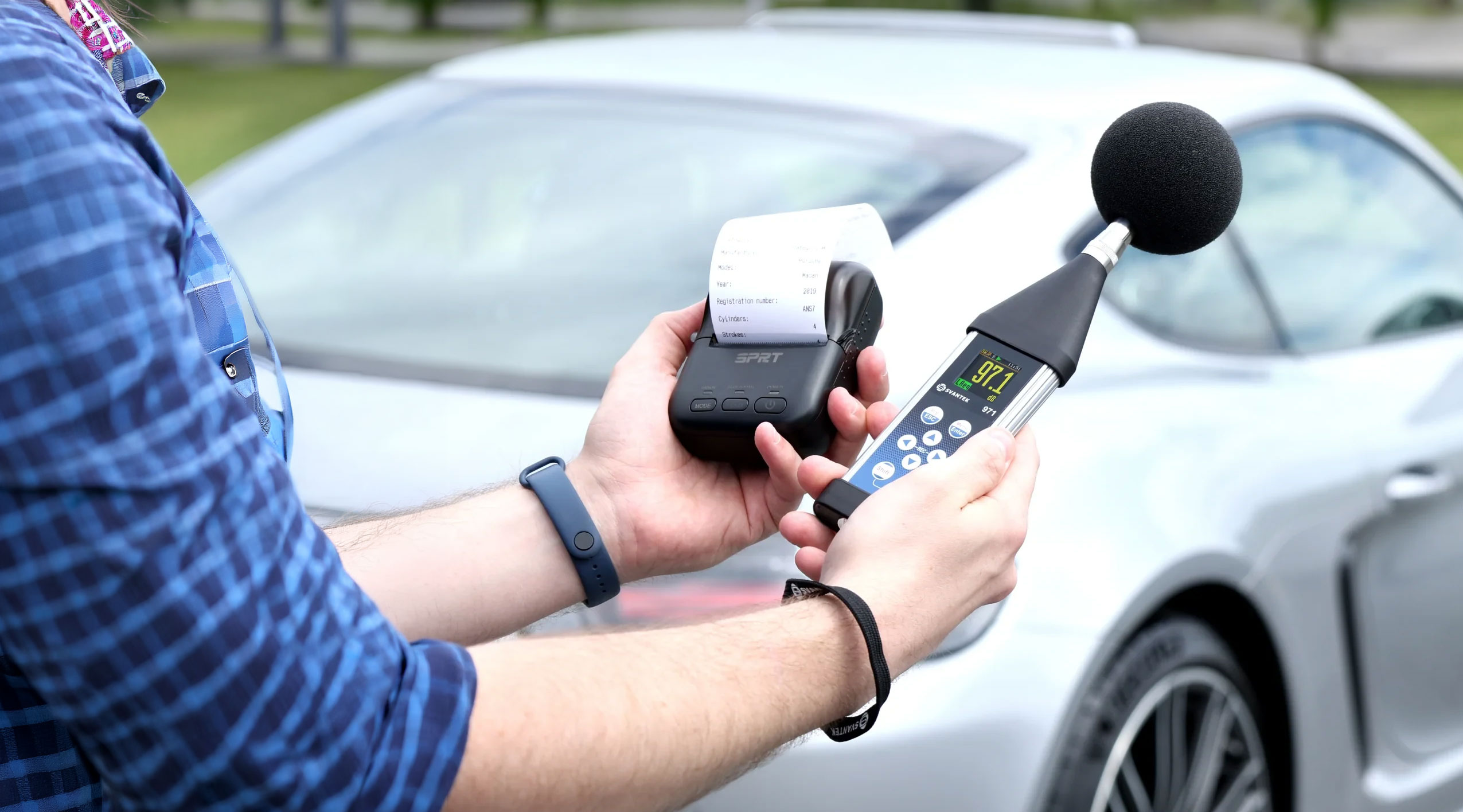
A complete, field-ready system that guides operators from acoustic calibration to a professional vehicle noise report.
Inside the solution
Inside the SV 971A Vehicle Noise Kit. Built around your measurement procedure.
Explore the core equipment and build the exact configuration required by your enforcement or inspection team.
01

SV 971A
Class 1 sound level meter
02

SV 33B
Class 1 acoustic calibrator
03

SP 73
Universal rev counter
04

SP 74
Portable wireless printer
Also included
OBD interface
Professional accessories
Dedicated tripod

SV 971A advantages
SV 971A Class 1 sound level meter. Precision built in, guidance in your hand.
Professional measurement performance meets a connected mobile workflow — for faster, clearer field operation and documentation that stands up to review.
Why procedure matters
ISO 5130 stationary noise testing: three things that make the result hold up
Engine speed at the specified point, the microphone within tolerance, and a measurement chain verified before and after. Get those right and the number stands on its own.

Engine speed drives the level
The test runs at a specified rpm. Live RPM feedback ensures precise engine speed control, supporting accurate and repeatable vehicle noise measurements.

Calibration makes it defensible
Calibration before and after, vehicle data and measured levels in one document — produced on site, not back at the office.
Assistant PRO workflow
How to measure vehicle noise, step by step. From microphone position to printed report.
01 — Position
Position the microphone
Assistant PRO shows the correct microphone position for the vehicle’s tailpipe layout.
02 — Identify
Identify the vehicle
Enter vehicle details once. They flow automatically into the final measurement report.
03 — Calibrate
Calibrate the measurement chain
Verify the complete measurement chain before and after the test with the supplied Class 1 calibrator.
04 — Connect rpm
Connect the rpm source
Pair the OBD rpm interface — or use an alternative compatible rpm accessory.
05 — Measure
Measure at the target engine speed
Monitor engine speed live. The app tells the driver when to release the throttle, for a repeatable procedure.
06 — Report
Generate and print the report
Generate a complete report and print it in the field — immediately and professionally.
The complete solution
The complete vehicle noise measurement chain.
Four instruments, four numbers that actually matter — for police, road authorities, inspection stations and environmental professionals.
01
Class 1 Instrument
SV 971A sound level meter
02
Acoustic calibration
SV 33B — 114 dB reference, before and after

03
Live rpm guidance
Assistant PRO App with OBD and SP 73
04
Instant reporting
SP 74 wireless printer, on site
Linear operating range, IEC 61672
0140 dBHover, tap or tab through the cards.
The dial re-scales to each instrument — decibels for the meter and the calibrator, rpm for the guided test.
See it in action
The ISO 5130 workflow in Assistant PRO App. Compliant, and remarkably simple.
Connect Assistant PRO and let the app guide the operator through positioning, vehicle data, calibration, engine-speed control, measurement and reporting.
ISO 5130 explained
Vehicle noise measurement. Frequently asked questions.
The requirements behind a stationary vehicle noise test — instrumentation, microphone position, engine speed, reporting.
What is ISO 5130?
ISO 5130 is the acoustics standard for measuring the sound pressure level emitted by stationary road vehicles. It applies to categories L, M and N with internal combustion engines and is used for type approval, checks at the manufacturing stage, official testing stations and roadside testing. The level is measured close to the exhaust outlet, with the vehicle stationary.
What instruments does an ISO 5130 vehicle noise test require?
A sound level meter meeting Class 1 of IEC 61672-1, used with A-weighting and F time weighting, together with a Class 1 sound calibrator to IEC 60942 and an engine-speed instrument accurate to at least ±2 %. The SV 971A Vehicle Noise Kit brings all three together — the SV 971A meter, the SV 33B calibrator and rpm reading through the OBD interface or the SP 73.
Where is the microphone positioned for a stationary vehicle noise test?
At 0,5 m ± 0,01 m from the reference point of the exhaust outlet and at 45° ± 5° to the vertical plane containing the flow axis of the pipe. The microphone sits at the height of the reference point, never lower than 0,2 m above the ground, with its reference axis aimed at the outlet. Assistant PRO shows the geometry for the vehicle's tailpipe layout.
What engine speed is used for the test?
The target engine speed depends on the rated engine speed, S. For categories M and N it is 75 % of S up to 5 000 min⁻¹, 3 750 min⁻¹ between 5 000 and 7 500 min⁻¹, and 50 % of S from 7 500 min⁻¹ upwards. Category L uses 75 % of S up to 5 000 min⁻¹ and 50 % above it. The tolerance is ± 5 %.
How is the measurement carried out?
Engine speed is raised gradually from idle to the target value and held steady for at least one second, then the throttle is released rapidly and the engine returns to idle. The sound pressure level is measured across the steady phase and the whole run-down, and the maximum reading is taken as the test value. Assistant PRO displays live rpm and signals the release moment, so the operator is not estimating.
What result is reported, and how is it calculated?
The test is repeated at each outlet until three consecutive values fall within 2 dB of each other. Their arithmetic mean, rounded to a whole decibel, is the reported A-weighted sound pressure level LArep. Where a vehicle has several outlets more than 0,3 m apart, each is measured separately and the highest average is reported.
Why is the calibrator used before and after the measurement?
The complete measurement chain is checked with a Class 1 calibrator at the start and at the end of every measurement session. If the two checks differ by more than 0,5 dB without any adjustment in between, the results taken since the last valid check have to be discarded. The SV 33B supplies a 114 dB reference at 1 kHz for both checks.
What site and weather conditions does the standard require?
A level, hard outdoor surface — concrete, dense asphalt or similar — free of large reflecting objects within 3 m of the microphone and of any point of the vehicle. Wind, including gusts, must stay at or below 5 m/s, and background noise at least 10 dB below the level being measured. A semi-anechoic chamber meeting the same acoustic requirements may be used instead.
What has to be included in the ISO 5130 test report?
A statement that the test followed ISO 5130, the test site with ground and weather conditions, the measuring equipment including the windscreen, the typical A-weighted background level, identification of the vehicle with its engine and transmission, a description of engine and exhaust outlet location, the microphone position and orientation, the engine speed used and the resulting level LArep. The SP 74 wireless printer produces it on site.
Can the measured level be compared with a noise limit?
ISO 5130 does not set general noise limits. A vehicle in use is assessed by comparing its result with a reference measurement made by the same method — for example at type approval, or the figure recorded in the registration documents. Because of measurement uncertainty (1,9 dB site-to-site at 80 % coverage probability), differences below 5 dB should not be treated as significant.

Academy
How loud motorsport really is, why race engines exceed 130 dB and how static exhaust measurements are used to screen vehicles before they enter the circuit.
Read more

Case study
Tor Poznań uses the SV 307A monitoring station and SvanNET for 24/7 Class 1 noise oversight, real-time alerts and AI-assisted classification of racing events.
Read more
Case study
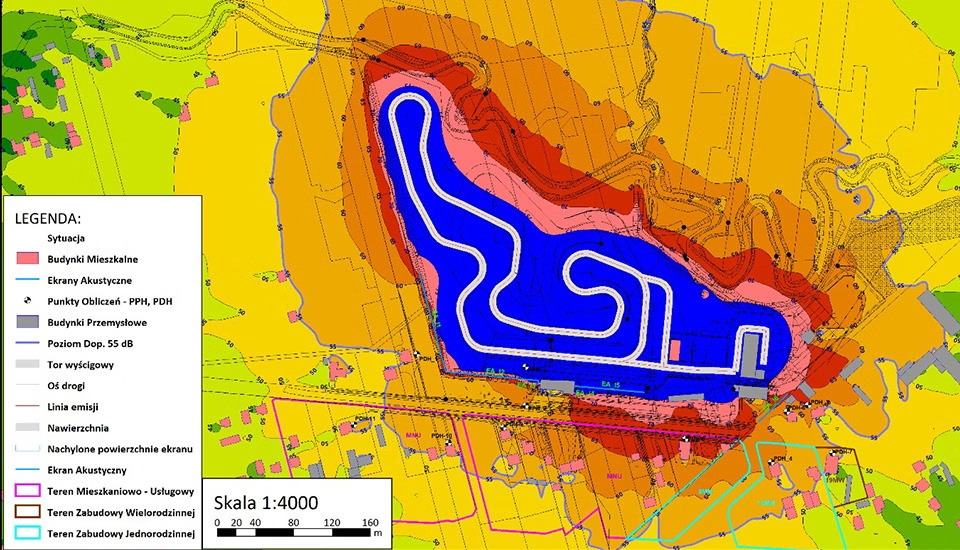
At Autodrom Biłgoraj, continuous SV 307A measurements fed an acoustic map showing how motorcycle racing noise spreads across the surrounding area.
Read more
Check availability & price
Tell us about your measurement needs
Describe your vehicles and the standard you test to. We will come back with the right SV 971A Vehicle Noise Kit setup.
