

Integrated blast monitoring
Blast Vibration and
Air-Overpressure Monitoring System
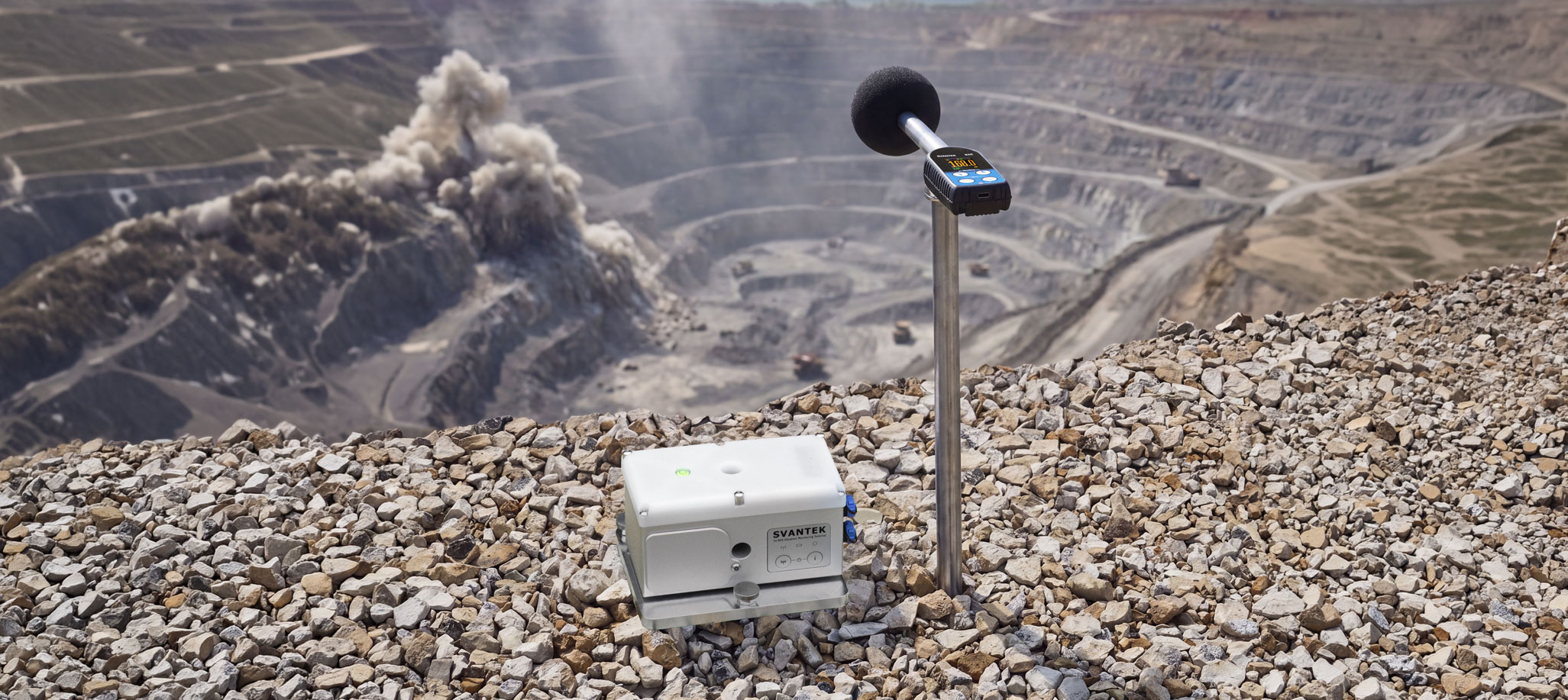
Combine SV 810 air-overpressure measurement with SV 804 ground-vibration monitoring to capture, analyse and document the complete blasting event.
168 dB Peak
Air-overpressure range
2 – 250 Hz
Linear weighting
ISEE 2022
Air-overpressure standard
Class 1
Vibration, DIN 45669-1
One event, two instruments
Why blast vibration and air overpressure
arrive at different times.
A blast generates both ground vibration and air overpressure. Because they propagate through different media at different velocities, they reach the monitoring point at different times. Together, PPV, frequency and peak air overpressure provide a more complete record of the blast event.
Schematic representation of a blast record. Actual arrival times, amplitudes and waveforms depend on charge design, distance, geology and weather.
Ground
Blast vibration (PPV) reaches the structure
Peak particle velocity and dominant frequency are what building-damage criteria are written around. The SV 804 measures all three axes to Class 1 and flags events against your PPV thresholds automatically.
Air
Air overpressure travels further than vibration
Air overpressure can be perceptible beyond the range at which vibration is felt, and is often reported as window or structural rattle. The signal is impulsive and low in frequency; the SV 810 measures it from 2 Hz and up to 168 dB Peak.
The system
One blast monitoring system,
two instruments.
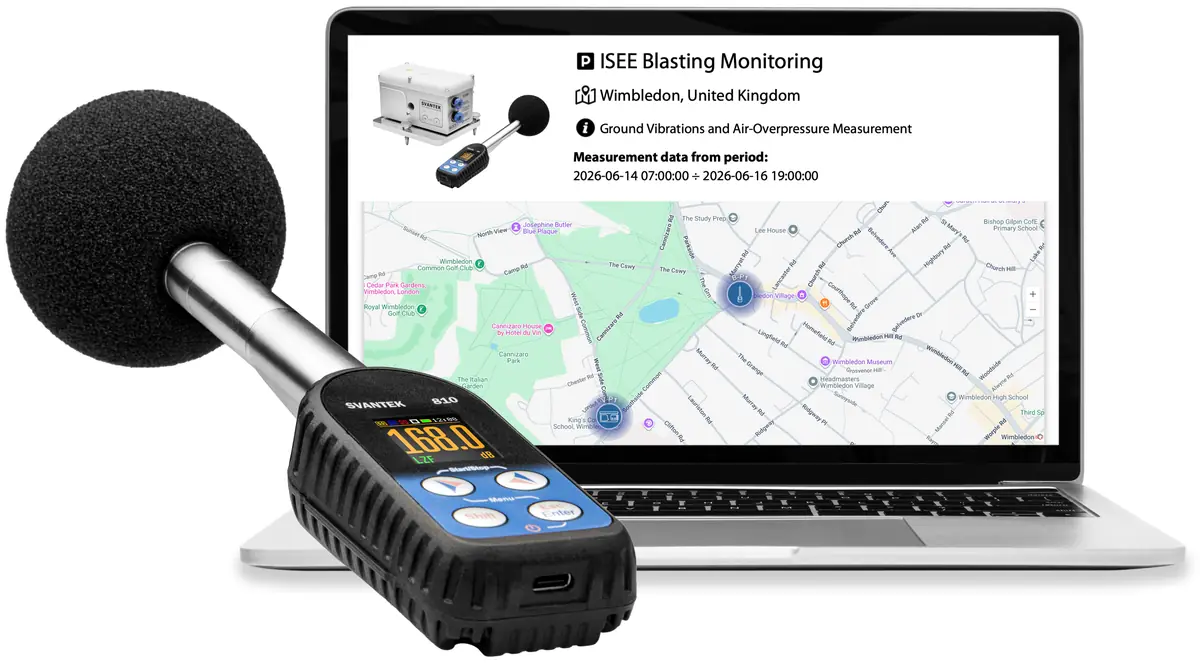
Use the SV 810 on its own for spot checks, or connect it to a monitoring station so both instruments report to the cloud together.
Ground vibration
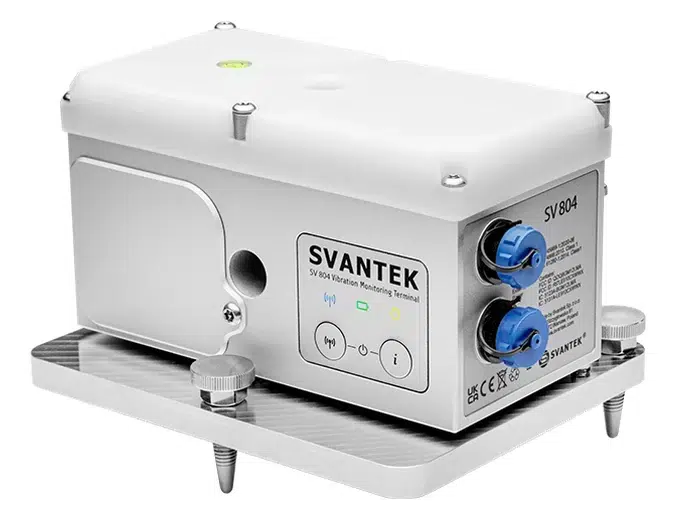
SV 804
Wireless triaxial vibration monitor
A compact station that mounts directly to a structure or to the ground. It detects events from PPV thresholds and dominant frequency, and sends alerts by SMS and email without an operator on site.
Air overpressure
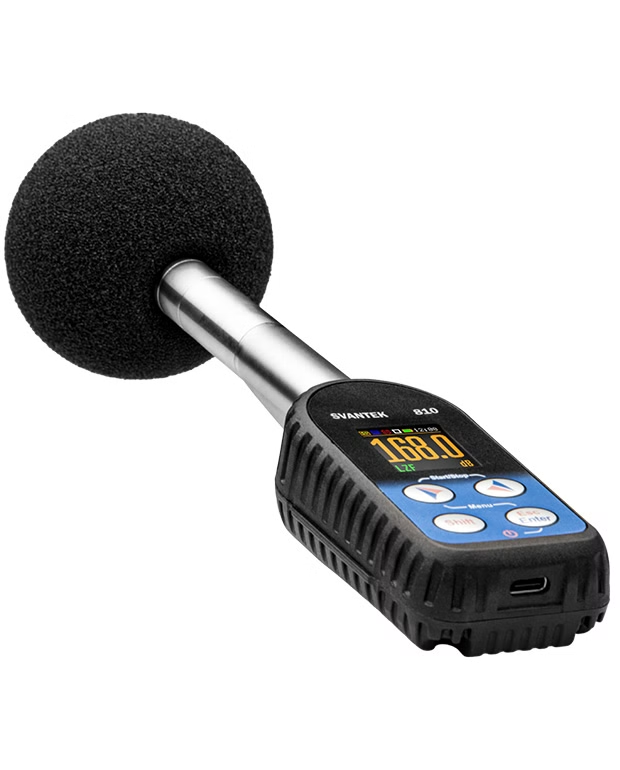
SV 810
Air-overpressure meter
A dedicated blast instrument built around a solid-state piezoresistive pressure transducer. It measures Lpeak, Lmax, Lmin, Leq and overload in both pascals and decibels, and calculates dominant frequency on board.
Inside the system
Blast monitoring standards:
ISEE 2022 and DIN 45669-1.
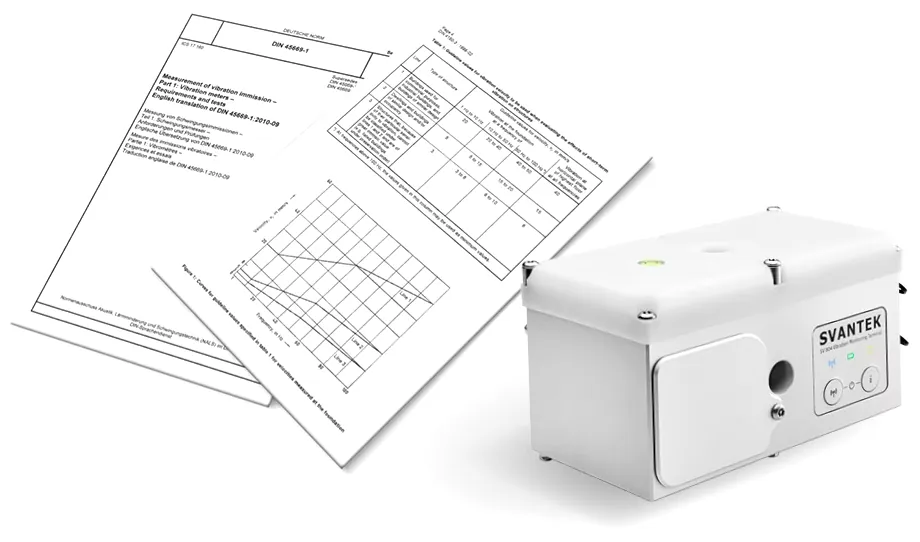
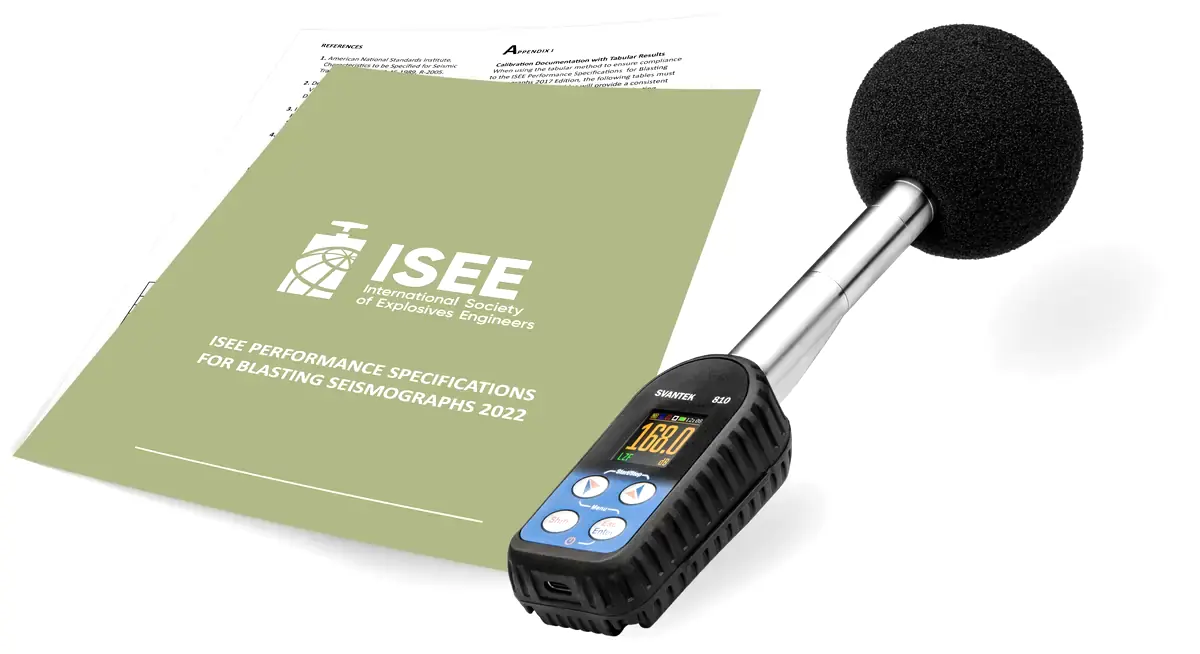
Blast records get read by regulators, contractors and third-party engineers. The SV 810 follows the ISEE Performance Specifications for Blasting Seismographs (2022); the SV 804 is a Class 1 instrument to DIN 45669-1.
Ground vibration
SV 804
Class 1 vibration monitoring to DIN 45669-1 and ISO 4866
The SV 804 is a Class 1 instrument that measures peak particle velocity on three axes in accordance with DIN 45669-1 and ISO 4866. Dominant frequency is evaluated on board against DIN 4150-3 or BS 7385-2 criterion curves.
Air overpressure
SV 810
Air overpressure engineered around ISEE 2022
The meter is designed to meet the frequency-response and amplitude requirements of the ISEE 2022 Performance Specifications, with a digital true RMS detector at 0.1 dB resolution and an internal noise floor below 95 dB Peak.
On site
Built for unattended
monitoring on site.
Setup
Configure it right where you use it
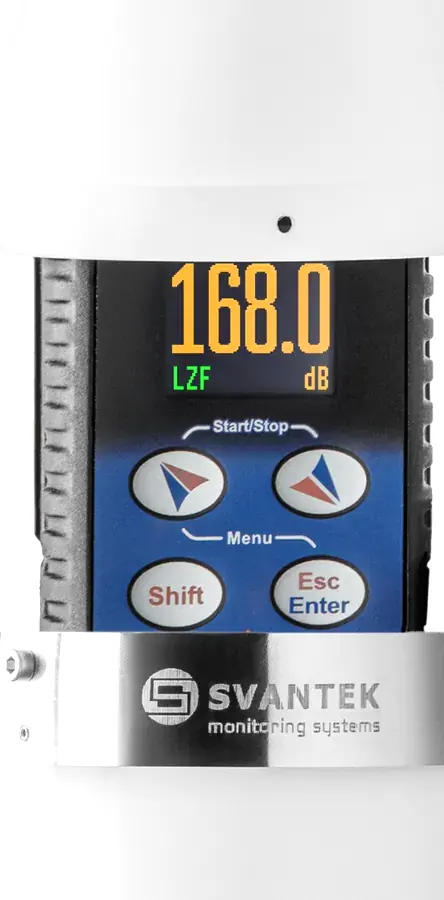
An OLED display and four-button keypad put the complete setup on the instrument — stand-alone, in the field, in seconds.

Protection
Robust and weatherproof for outdoor monitoring
Both instruments are built to stay outside. Rain, dust, heat or frost — the SV 804 and the SV 810 in its SA 810 enclosure keep measuring through all of it.
Evidence
Time history, WAV recordings and FFT analysis
On-demand WAV event recordings, time-history data and optional 1600-line real-time FFT give reviewers the raw signal behind every number.
See it in action
See the SV 810
air-overpressure meter
on site.
Watch how the meter is deployed, set up on site and connected into a monitoring system for blast documentation.
Air-Overpressure Meter for Blast Monitoring · SV 810
From detonation to documentation
How blast monitoring works
— four steps, every blast.
The sequence below is what a monitoring round actually looks like on a working site — whether you run one meter or a network of points.
01
Deploy the blast monitors
Put the SV 810 on a stand for a spot check, or install it in the SA 810 enclosure and cable it to an SV 804 for unattended monitoring.
02
Capture the blast event
Both instruments record the same blast. The SV 810 measures peak air overpressure and its dominant frequency; the SV 804 measures PPV and dominant frequency on three axes.
03
Review and document the event
Download the logged data from the meter. WAV recordings and FFT results are included, so each number can be verified. SvanNET adds remote viewing and reporting when you need it.
04
Report the results
Issue a traceable record for the regulator, the client or the neighbour who called — built on standards-based measurement, not estimation.
Documentation
SV 810 and SV 804 data sheets
for your team.
Individual data sheets for each instrument, plus the leaflet covering the complete monitoring system.


PDF · complete system
SV 810 with SV 803 and SV 804 — standards, key functions, software, accessories and full technical specification in one document
Where it works
Blast monitoring in mining,
quarrying and construction.
Mining
Surface mining
Daily production blasts documented against environmental limits, blast after blast.
Aggregates
Quarries
Boundary points that record what reaches the community next door.
Underground
Tunnel excavation
Confined, low-frequency blast effects measured in the drive itself.
Civil works
Construction blasting
Controlled excavation beside buildings, utilities and live infrastructure.
Urban
Demolition
Standards-based acoustic and vibration reporting that satisfies city regulators.
Your site
Every site is different.
Tell us the distance to the nearest structures and what you have to report — we’ll suggest the right setup.
Check availability & price
Request a quote for blast monitoring.
Tell us the distance to the nearest structures, the limits set for the site and what you have to report. We will propose instruments, measurement points and a reporting setup.
