

Svantek » Academy » Noise measurements » Class 1 or Class 2 noise dosimeter?

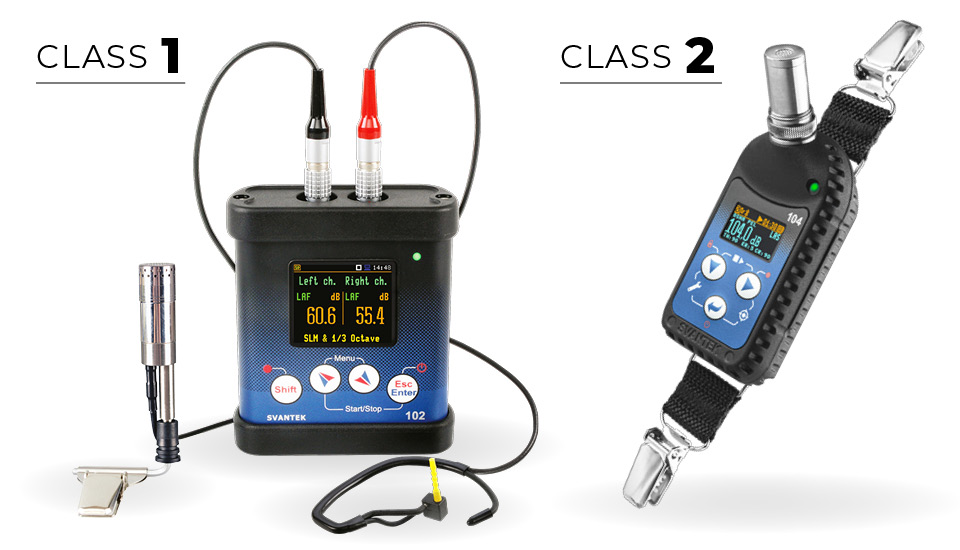
A personal noise dosimeter is a specialized acoustic measurement device that continuously logs sound pressure levels and calculates the equivalent continuous level of occupational noise exposure over a work shift. Under the normative frameworks of IEC 61252 and its US equivalent, ANSI S1.25, wearable personal noise dosimeters feature only one defined performance tier, whose baseline design goals and acceptance limits correspond strictly to the Class 2 specifications of the internationally harmonized IEC 61672-1 standard.
The ISO 9612 methodology explicitly recognizes and recommends deploying personal sound exposure meters that simultaneously fulfill the stricter Class 1 requirements of IEC 61672-1 when assessing challenging environments. Advanced engineering allows a wearable dosimeter to exceed the baseline Class 2 limitations, providing necessary accuracy when the ambient noise profile is subjected to very low temperatures or dominated by high frequencies. For instance, while a standard dosimeter exhibits wide measurement tolerances to 8 kHz, a device engineered to meet Class 1 performance maintains strict acoustic tolerances up to 16 kHz. Evaluating the acoustic landscape against extreme physical variables and specialized measurement protocols is critical for determining whether a baseline device suffices or if a dosimeter fulfilling Class 1 specifications is required to maintain metrological integrity. This evaluation ensures strict adherence to international and regional occupational noise exposure limits, including OSHA and NIOSH mandates, while actively minimizing the measurement uncertainty budget.
Determining whether an environment requires a Class 1 or Class 2 noise dosimeter is not merely a purchasing decision but a fundamental risk management protocol.
Relying on standard Class 2 instrumentation in environments experiencing severe cold or extreme heat directly compromises the integrity of the collected occupational exposure data.
As industrial machinery increasingly introduces high-frequency noise components, the 8 kHz limitation of Class 2 devices actively prevents the accurate capture of potentially hazardous high-frequency audible noise.
Implementing advanced assessment techniques like MIRE strictly necessitates a fully integrated Class 1 measurement ecosystem to analyze individual acoustic immissions accurately under ISO rules.
Ultimately, the quantifiable uncertainty budget provided by Class 1 precision ensures metrological conformance, providing the robust, standardized data required to assess the risk of hearing impairment and navigate legal consequences related to occupational compensation.
Analyzing ambient workspace conditions directly determines whether an environment requires standard Class 2 performance or the enhanced precision of a Class 1 device. Standard Class 2 acoustic tolerance limits are not suited for extreme thermal ranges (outside 0 °C to +40 °C) or complex, high-frequency spectrums. When acoustic assessments move into these challenging operational environments, ISO 9612 guidelines recommend utilizing instruments that meet Class 1 specifications. Utilizing these higher-tier devices ensures that the frequency weightings and environmental tolerances remain strictly controlled, reducing measurement uncertainty and preventing significant data drift.
| Environment / Task | Recommended Class | Metrological Justification |
|---|---|---|
| Baseline Industrial Settings | Class 2 (Type 2) | Meets standard OSHA/NIOSH compliance for mid-range noise. |
| Cold Storage / Sub-Zero Operations | Class 1 (Type 1) | Requires extended thermal stability below 0 °C to prevent data drift. |
| High-Speed Turbines / Compressed Air Nozzles | Class 1 (Type 1) | Demands frequency weighting response accuracy up to 16 kHz. |
| Aviation / Dispatch Headset Use | Class 1 (Type 1) | Strictly mandated by ISO 11904–1 (MIRE) protocols. |
Extreme temperatures disrupt the delicate sensitivity of a microphone, directly impacting the environmental drift and thermal stability of the recording unit. The required precision class is dictated by the specific thermal stability range engineered into the device’s internal acoustic components. Upgrading to a dosimeter meeting Class 1 performance is recommended for environments dropping below the zero-degree threshold, as these instruments maintain strict tolerance margins across a broader thermal spectrum of -10 °C to +50 °C. Operating a standard Class 2 device in extreme cold environments (outside its 0 °C to +40 °C specification) inevitably increases measurement uncertainty, leading to unreliable equivalent continuous level data and potentially invalidating the true occupational exposure assessment. Consequently, analyzing the ambient temperature profile serves as the first definitive step in resolving equipment selection for harsh climates.
High-frequency dominance within a workspace introduces severe measurement errors when captured by standard mid-range acoustic equipment, directly answering when advanced capabilities are required. The official nominal frequency range for Class 2 dosimeters terminates at an 8 kHz absolute ceiling, beyond which their permitted lower acceptance limit drops to negative infinity and renders them incapable of registering higher sounds. However, a critical warning zone begins much earlier at 4,000 Hz, where the allowed margin of error for a Class 2 device expands rapidly to ±3.0 dB and widens further to ±5.0 dB by 8,000 Hz. Because this expanding measurement uncertainty easily leads to incorrect exposure assessments for high-frequency sources like compressed air nozzles, ISO 9612 dictates that simply restricting frequency analysis bands is an inadequate solution. Instead, the standard mandates a transition to a Class 1 sound level meter, which maintains significantly tighter tolerance limits—such as ±1.0 dB at 4 kHz and +1.5/-2.5 dB at 8 kHz—while extending reliable acoustic measurements up to 16 kHz.
The implementation of specialized methodological protocols definitively answers the central query regarding necessary precision by removing the choice between instrument classes. The ISO 11904-1 standard, which governs the Microphone in Real Ear (MIRE) technique, focuses on evaluating sound immissions from sources placed close to the ears, including occupational noise exposure directly beneath communication headsets or helmets. Because under-ear measurement techniques assess individual frequency responses in an extremely confined space, the standards strictly mandate the use of Class 1 precision to manage the measurement uncertainty. Specifically, the reference field microphone and all connected data logging equipment must fulfill the requirements for a Type 1 (Class 1) instrument or better.
According to ISO 9612 guidelines, these highly specialized MIRE protocols must be deployed for specific operational profiles where standard external dosimetry cannot accurately capture the noise reaching the eardrum, such as:
Conducting MIRE assessments requires high precision to manage measurement uncertainty and reliably determine sound immissions from sources placed close to the ear.
Sustaining metrological traceability throughout the entire data collection process is essential to validate the continuous monitoring of workplace hazards. The metrological integrity of the measurement chain relies entirely on matching the acoustic calibrator class to the precision of the primary dosimeter. International ISO 9612 methodology and fundamental metrological principles clearly establish that pre-measurement field calibration must be executed with a calibrator that equals or exceeds the metrological class of the primary instrument. Deploying mismatched calibration equipment introduces unacceptable uncertainty that violates the strict measurement uncertainty budget, while a formal invalidation of an entire measurement session specifically occurs only if the field calibration reading drifts by more than 0.5 dB between the beginning and end of the series. Therefore, environmental requirements dictate not only the selection of the wearable device but also the configuration of the entire supporting calibration ecosystem.
A Class 2 acoustic calibrator possesses an inherent uncertainty budget that fundamentally prevents it from verifying the stringent tolerances of Class 1 instrumentation. The metrological verification hierarchy dictates that a reference standard must always equal or exceed the metrological class of the field device being calibrated. Attempting to verify a high-precision instrument with a lower-class calibrator introduces unacceptable measurement uncertainty that violates the strict uncertainty budget defined by international standards. While a formal invalidation of a measurement series specifically occurs if the calibration reading drifts by more than 0.5 dB between the beginning and end of the session, deploying a mismatched calibrator compromises the metrological traceability of the assessment. Consequently, managing a Class 1 ecosystem requires strict adherence to Class 1 calibration tools without exception.
To optimize equipment selection based on rigorous metrological and legal needs, specific instrument attributes must be compared systematically to assess their impact on data defensibility across global jurisdictions.
| Metrological Parameter | Class 1 Specification | Class 2 (Dosimeter Baseline) Specification | Impact on Uncertainty Budget |
|---|---|---|---|
| Tolerance Limits (Level Linearity) | Tight margin (e.g., ±0.8 dB) | Standard margin (e.g., ±1.1 dB) | High (Minimizes legal vulnerability) |
| Frequency Range | Extended (Up to 16 kHz) | Standard (Up to 8 kHz) | High (Captures hazardous high-frequency noise) |
| Thermal Stability | Broad (−10°C – +50°C) | Standard (0°C – +40°C) | Critical (Prevents environmental drift) |
| Filter Compliance | Class 1 One-third-octave-band ready | Standard A/C/Z weighting | Critical (Strictly required for MIRE technique) |
The reliability of occupational hearing loss assessments relies heavily on quantifying error margins and managing the measurement uncertainty budget. High measurement uncertainty systematically undermines the metrological value of the exposure data. A minimized uncertainty budget can be achieved by utilizing Class 1 precision instruments, which feature tighter tolerance limits and stricter resistance to environmental drift (such as temperature and static pressure variations). However, standard Class 2 instruments, including wearable personal noise dosimeters, remain fully compliant and valid for baseline industrial assessments. Relying on Class 2 data only introduces unacceptable metrological vulnerability when acoustic assessments move into extreme operational environments—such as freezing temperatures or high-frequency spectrums—where international standards like ISO 9612 dictate a preference for Class 1 equipment to prevent significant data drift.
Transitioning from theoretical metrological standards to practical application requires instrumentation engineered to withstand severe operational stressors. The Svantek ecosystem provides specialized solutions across the precision spectrum utilized daily in diverse industrial environments. The SV 104A operates as a highly robust Class 2 personal noise dosimeter, ideal for standard baseline compliance. For environments demanding elevated metrological precision, the SV 102A+ Class 1 dual-channel dosimeter (capable of executing under-ear MIRE assessments) and the SV 971A Class 1 sound level meter deliver the tight acoustic tolerances mandated by ISO guidelines.
The metrological stability of these devices is validated not only in demanding terrestrial industries but also in the most extreme operational environments imaginable: space exploration. Svantek instrumentation has been successfully deployed in joint missions with AXIOM, ESA, and NASA. Demonstrating the critical need for Class 1 precision in high-stress acoustic environments, the SV 102A+ was recently utilized during the Artemis II lunar mission in April 2026 to monitor the astronauts’ exposure. Further technical details regarding these extraterrestrial deployments can be found in the Svantek Space Mission Project.
The term “Type” represents nomenclature historically utilized in United States ANSI standards (e.g., ANSI S1.4 Type 1 / Type 2), whereas “Class” is the standardized terminology defined by the international IEC 61672-1 framework. Both designations represent the identical tier of metrological precision and measurement tolerance. However, it is important to note that under the IEC 61252 standard for personal noise dosimeters, there is technically only one performance class, whose design goals correspond to baseline Class 2 (or Type 2) specifications. If higher precision is required, an environment necessitates either a location-based Class 1 sound level meter or a specialized dosimeter engineered to exceed the baseline and meet Class 1 performance specifications.
A standard Class 2 dosimeter successfully captures C-weighted peak sound levels within its designated thermal operating range of 0 °C to +40 °C and up to a frequency threshold of 8 kHz. However, if the acoustic environment features severe thermal fluctuations outside this range, or is dominated by high-frequency audible noise (such as compressed air emissions between 8 kHz and 16 kHz), the instrument’s measurement uncertainty increases significantly. In these extreme environments, international guidelines (such as ISO 9612) dictate an upgrade to Class 1 precision equipment to ensure hazardous peak events and high-frequency continuous exposures are accurately registered without significant data drift.
An authorized SVANTEK consultant will help You with the details such as the required accessories for your noise monitoring task.
