

Svantek » Academy » Noise measurements » White Noise and Pink Noise in Acoustics
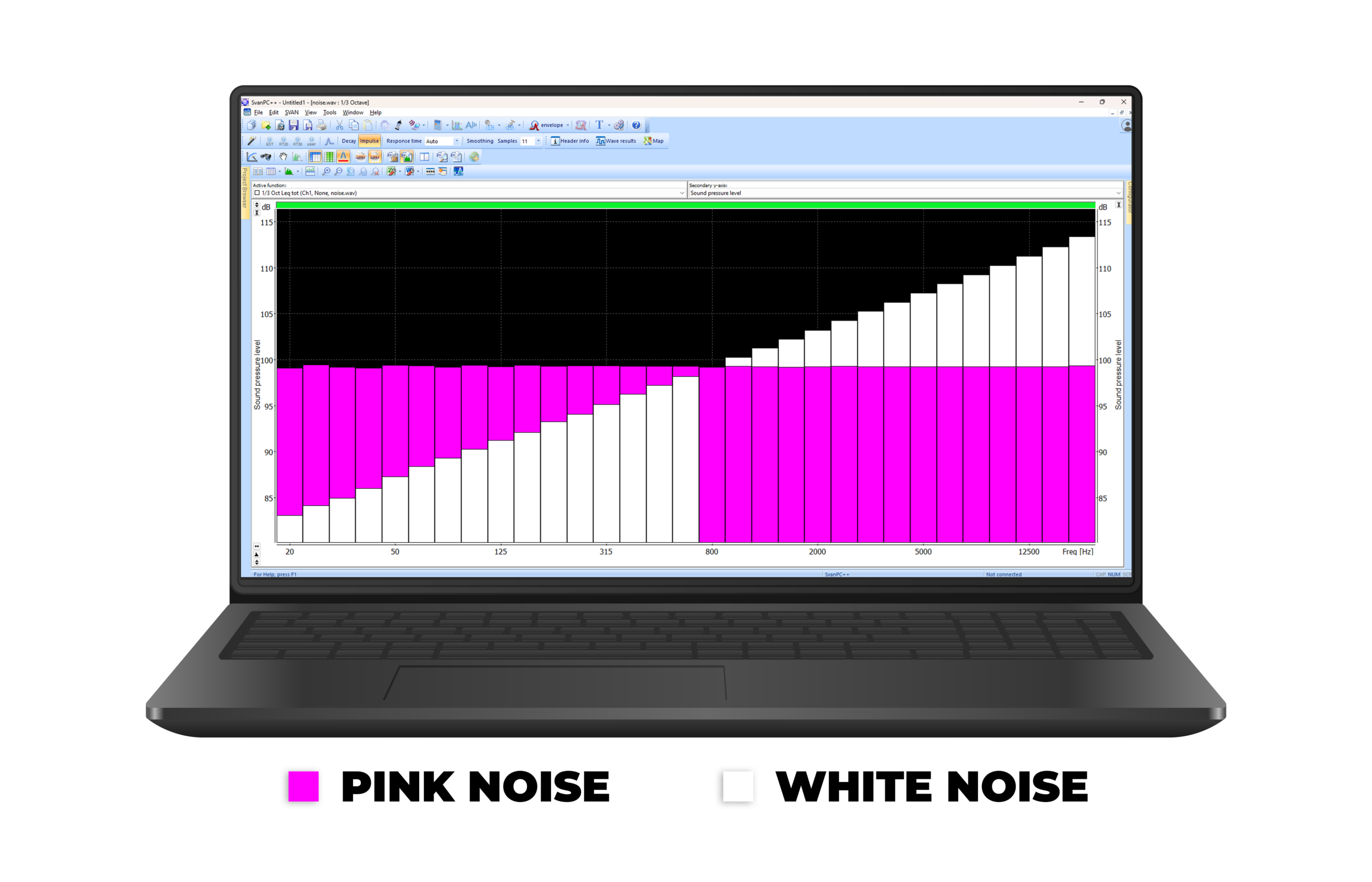
White noise and pink noise play a very important role in engineering acoustics. They are used in testing as controlled excitation signals. What matters most is their spectrum, which ensures evenly distributed energy across a defined frequency band.
Noise is useful for measuring rooms, loudspeakers, and building partitions, especially when the recorded sound results from the interaction of a sound source with the system under test. If we know the characteristics of the source, we can determine precisely how the system under test changes the distribution of acoustic energy.
In acoustic testing, when the test signal is known, we can assess to what extent specific frequencies are attenuated or amplified by a given room. And because noise covers the whole frequency range, all frequencies can be tested in a single run of the test signal.
The most common test signals include white noise, pink noise, sine waves, sweeps, and MLS. Engineering acoustics uses different test signals depending on the purpose of the measurement. The choice of excitation depends on whether we are testing frequency response, impulse response, sound insulation, or other parameters.
A sine wave is a signal at a single frequency. It is well suited to determining harmonic distortion and phase shifts between two systems.
A sweep is a sine wave with a varying frequency, used in measurements of room impulse responses and of loudspeaker and audio signal chain responses.
MLS (maximum length sequence) is a pseudo-random sequence similar to white noise. Unlike white noise, MLS repeats exactly, which is a major advantage when you need synchronization and easy averaging of results.

White noise is a special type of signal in which every frequency interval of equal width carries the same signal power. It is random noise with a constant power spectral density.
Ideal white noise has the same average power from 100 to 200 Hz as from, for example, 1000 to 1100 Hz. Each of these intervals is 100 Hz wide, so their average power is also identical. The time waveform of white noise itself is irregular, but its expected average values are precisely defined.
Pink noise is a random signal whose power spectral density decreases in inverse proportion to frequency. As frequency increases, each interval of constant width receives less and less power.
The most important aspect of this noise is that every octave band contains the same power. This means that the 125–250 Hz and 1000–2000 Hz octaves carry the same average power.
Pink noise is an excellent fit for octave and one-third octave analysis, because its spectrum is flat in these bands. For frequency intervals of equal width, pink noise shows a larger share of low frequencies than of high frequencies, whereas for white noise this share is equal.

Pink noise is particularly useful in acoustic measurements based on octave and one-third octave band analysis. If the sound source generates pink noise and the system under test has a flat frequency response, we should obtain similar levels in successive octave bands at the output.
If the output is not flat, this reflects the frequency response of the system under test (after accounting for the response of the source and the measurement chain). When we know the input signal and measure the output signal, we can determine the system’s frequency response.
Keep in mind that the levels are equal only with flat frequency weighting. With the commonly used A-weighting, the bands do not have equal levels. The generated noise is also not ideal: the loudspeaker and other elements of the chain affect the signal.
Unlike pink noise, white noise shows levels that rise with each successive octave in measurements, because the bandwidth increases.
Noise is a natural choice for reverberation time measurements in room acoustics. In a reverberation time measurement using the interrupted noise method, the room is excited with sufficient acoustic energy, and after the source is switched off, the time it takes the sound pressure level to decay is recorded. The rate of this decay determines the reverberation time in the given frequency bands.
Pink noise is useful here because its energy is evenly distributed across successive octaves, which makes it possible to obtain adequate levels in many bands at the same time. Because the excitation is random, the procedure is repeated many times and the results are analyzed statistically.
The interrupted noise method is one of the two methods defined in ISO 3382-2, “Acoustics—Measurement of room acoustic parameters—Part 2: Reverberation time in ordinary rooms.”
Noise is also used in sound insulation measurements. The sound insulation of partitions depends strongly on frequency. A wall or a door may attenuate sound more effectively in one frequency band and less effectively in another.
To assess performance across the whole band, the source room is excited with a suitable noise signal, and the sound pressure levels are then measured in both rooms. White or pink noise is used, and when the signal-to-noise ratio in the receiving room is too low at high frequencies, the signal spectrum can be shaped accordingly. The level difference between the signal in the source room and the signal in the receiving room characterizes how effectively the partition between the rooms attenuates sound.
The methodology is described in detail in the ISO 16283 series, “Acoustics—Field measurement of sound insulation in buildings and of building elements,” for field measurements, and in the ISO 10140 series, “Acoustics—Laboratory measurement of sound insulation of building elements,” for laboratory measurements. For laboratory measurements, Part 5 of the ISO 10140 series (ISO 10140-5) recommends using white noise. Single-number ratings of sound insulation follow different procedures in different standards. ISO 717-1 gives Rw (laboratory) and R’w or DnT,w (field), while ASTM E413 in the US gives STC (laboratory) and NIC or ASTC (field); each result is quoted in the rating of the standard used for the test and is not converted.
Noise signals are also used in testing loudspeakers and electroacoustic systems. Noise is an effective way to measure frequency response. To interpret the response of the loudspeaker itself correctly, other influences on the measurement results must be limited or accounted for. Noise is also used in loudspeaker endurance testing.
White noise is also used as controlled background noise. By introducing noise into the system, we can assess how a device or algorithm responds to acoustic interference. This is one of the methods for testing speech recognition, noise reduction, and communication systems.
Speech intelligibility testing uses a specialized signal based on noise components. Unmodulated noise is not sufficient for these tests, because natural speech contains amplitude modulations over time.
STI (Speech Transmission Index) measurements use noise carrier signals with an appropriately shaped spectrum and known amplitude modulations. The base signal can be created from pink noise, which is then split into octave bands and shaped to match the speech spectrum. Amplitude modulations are applied to these bands, and the meter analyzes how well these modulations are preserved after passing through the speech transmission channel under test.
The test signal reproduces both the spectrum and the envelope fluctuations of natural speech because its spectrum is shaped and modulated. This makes it well suited to speech intelligibility measurements. Voice alarm and emergency communication systems are a typical application of STI measurement according to IEC 60268-16.
Acoustic test standards for noise-signal measurements carry international, European, and national designations. ISO and IEC publish the international methods, and the European standards (EN ISO, EN IEC) adopt them identically. BSI and DIN publish these European standards in the UK and Germany with the prefixes BS EN and DIN EN. The US uses its own ASTM methods for sound insulation and adopts the IEC specifications for sound level meters and filters as ANSI/ASA standards. The table lists the international standard for each measurement and its national publication or counterpart in each region.
| Measurement | International and Europe | US | UK | Germany |
|---|---|---|---|---|
| Reverberation time in ordinary rooms | ISO 3382-2 (interrupted noise method or integrated impulse response method) | No US equivalent; ANSI/ASA S12.60 (schools) refers to ISO 3382-2 for guidance on field checks | BS EN ISO 3382-2 | DIN EN ISO 3382-2 |
| Airborne sound insulation, field | ISO 16283-1 (white or pink noise recommended); rating: ISO 717-1 (R’w, DnT,w) | ASTM E336 (field method); rating: ASTM E413 (NIC, ASTC) | BS EN ISO 16283-1; rating: BS EN ISO 717-1 | DIN EN ISO 16283-1; rating: DIN EN ISO 717-1 |
| Airborne sound insulation, laboratory | ISO 10140-2 (method) and ISO 10140-5 (facilities and test signal; white noise recommended); rating: ISO 717-1 (Rw) | ASTM E90 (laboratory method); rating: ASTM E413 (STC) | BS EN ISO 10140-2 and BS EN ISO 10140-5; rating: BS EN ISO 717-1 | DIN EN ISO 10140-2 and DIN EN ISO 10140-5; rating: DIN EN ISO 717-1 |
| Speech intelligibility (STI, STIPA) | IEC 60268-16 | IEC 60268-16 | BS EN IEC 60268-16 | DIN EN IEC 60268-16 |
| Class 1 sound level meter and octave filters | IEC 61672-1 and IEC 61260-1 | ANSI/ASA S1.4/Part 1 and ANSI/ASA S1.11/Part 1 (identical adoptions of IEC 61672-1 and IEC 61260-1) | BS EN 61672-1 and BS EN 61260-1 | DIN EN 61672-1 and DIN EN 61260-1 |
Abbreviations: Rw—weighted sound reduction index; R’w—weighted apparent sound reduction index; DnT,w—weighted standardized level difference; STC—Sound Transmission Class; NIC—Noise Isolation Class; ASTC—Apparent Sound Transmission Class.
SVAN 979 is a Class 1 sound level meter and vibration analyzer with a built-in signal generator. The generator produces pink noise, white noise, and a sine wave.
The generator works with the RT60 reverberation time function: in the interrupted noise method, the meter outputs pink noise to drive the sound source, and after the signal is switched off, it records the level decay in one-third octave bands. SVAN 979 also measures reverberation time with the impulse method. The BA Assistant app guides the user through sound insulation measurements step by step.
Your SVANTEK distributor will help you choose the meter, sound source, and app for reverberation time and sound insulation measurements.
