
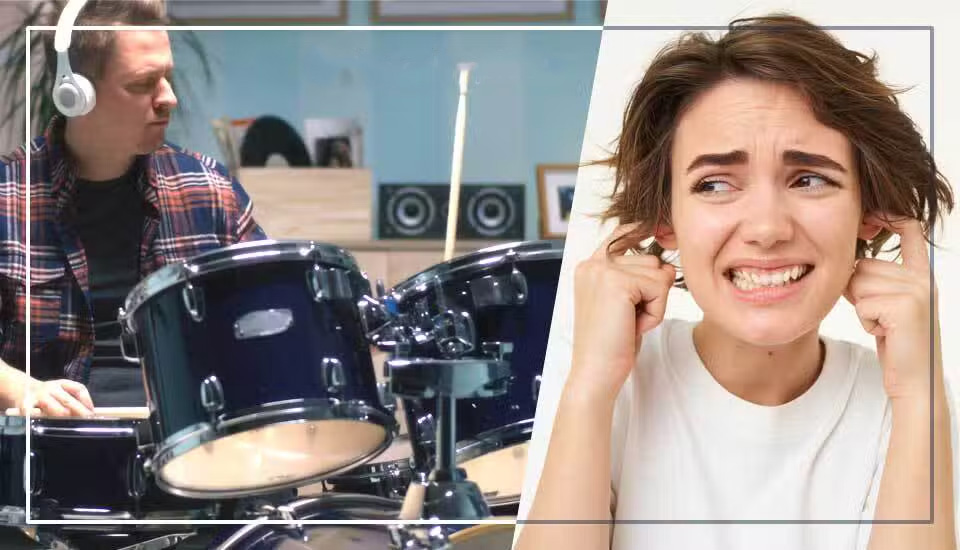
Neighbour noise typically refers to “unwanted sound” that transfers between dwellings via shared structures or air paths. This common issue is broadly categorised into airborne noise, such as loud music or conversation, and impact noise, which includes vibrations from footsteps, furniture movement, or slamming doors. Most buildings transmit these sounds because materials like timber and masonry conduct energy, while gaps in floorboards or shared service ducts allow sound waves to bypass insulation.
Acoustic Source Differentiation is Critical: Professional Acoustic Source Identification is the first step in resolution, as it distinguishes between behavioral human activity and mechanical infrastructure failures. This classification determines whether a resident should pursue a legal remedy for a nuisance or an engineering fix for structural defects.
Health Risks Mandate Compliance: Chronic exposure to neighbor noise triggers severe physiological responses, including cardiovascular stress and sleep deprivation. Because these conditions compromise long-term human health, maintaining acoustic standards is a matter of medical necessity and fundamental habitability rather than mere convenience.
Physical Pathways Dictate Solutions: Understanding the medium of propagation—whether airborne or structure-borne—is essential for selecting effective mitigation. Engineers use decoupling to break vibration paths and high-density materials to block airborne sounds that bypass walls through indirect flanking paths.
Standardised metrics, such as Weighted Standardised Level Difference (DnT,w+Ctr) for airborne noise and Weighted Standardised Impact Sound Pressure Level (L’nT,w) for structure-borne noise, provide the objective data required for court proceedings or insurance claims.
Neighbour noise arises from a combination of resident activity and the mechanical operations of a building’s infrastructure. Occupants generate airborne noise through everyday actions like playing music, using televisions, or engaging in loud conversation, which transmits sound waves directly through the air and across partitions. Impact noise occurs when physical contact with a surface—such as heavy footsteps on laminate flooring, moving furniture, or dropping objects—creates vibrations that travel through the floor-ceiling assembly as structure-borne sound.
Furthermore, internal building systems contribute to the overall acoustic load. Common mechanical sources include clattering plumbing pipes, humming HVAC or air conditioning units, and the cycling of elevator motors. Under Approved Document E of the Building Regulations, identifying these specific origins is essential for selecting the correct technical mitigation.
Chronic exposure to neighbour noise triggers physiological and psychological stress that compromises long-term health. Clinical studies demonstrate that persistent disturbances lead to cardiovascular stress and hypertension. Sleep disturbance is the most pervasive consequence, disrupting restorative cycles necessary for cognitive and immune function. Furthermore, a lack of acoustic privacy—the anxiety of being overheard—erodes the sense of security required in a domestic environment.
The UK legal framework addresses these risks by establishing a landlord’s responsibility to maintain habitable conditions. Most tenancy agreements include the Covenant for Quiet Enjoyment, a protection ensuring tenants can use their property without unreasonable interference. When noise exceeds reasonable levels, it may be classified as a statutory nuisance under the Environmental Protection Act 1990. This status allows residents to seek local authority intervention or pursue a rent abatement if management fails to enforce lease terms or address structural defects.
The physics of sound propagation defines how acoustic energy moves from a source to a receiver, providing the baseline for all professional building assessments. Occupants experience airborne transmission when sound waves travel through the atmosphere and penetrate walls or floors. Under Approved Document E, frequent complaints regarding airborne noise often indicate insufficient partition mass or a lack of acoustic privacy between dwellings.
In contrast, structure-borne transmission occurs when energy travels through the solid building skeleton—such as masonry walls, concrete slabs, or steel beams—allowing vibrations from one floor to be heard clearly several levels away. Impact noise is a critical sub-type of structure-borne sound caused by direct physical contact, such as footsteps or falling objects; it serves as a primary metric for determining whether a multi-family dwelling meets habitability standards.
By identifying whether sound is moving through the air or the building’s physical frame, acoustic engineers can select the correct mitigation strategy. This typically involves sealing air gaps and flanking paths in shared service ducts and decoupling structural components using resilient bars or floating floors to break the vibration path.
Acoustic specialists use source identification to distinguish between behavioural noise from residents and mechanical noise from building services. This distinction is vital because airborne sounds, such as voices or music, often involve different legal remedies than mechanical disturbances from lifts, HVAC systems, or water hammer in plumbing. By categorising the frequency range, technicians can determine if a nuisance is a low-frequency “thump” from a subwoofer or a high-pitched mechanical squeal; high-frequency sounds are generally mitigated with standard mineral wool, whereas low-frequency vibrations often require high-mass solutions or structural isolation.
Technicians also investigate flanking paths, which are indirect routes—such as shared floor voids, joist ends, or electrical sockets—that allow sound to bypass a main party wall. These “acoustic leaks” explain why a wall built to Approved Document E standards may still fail if the sound finds a secondary air or structure-borne path. Pinpointing these pathways is essential to determine if an issue stems from a neighbour’s “unreasonable use” or a fundamental architectural defect. Once confirmed, property managers can implement targeted engineering, such as acoustic sealants for gaps or anti-vibration mounts to dampen mechanical noise at the source.
A Class 1 Sound Level Meter compliant with BS EN 61672-1 is essential for professional-grade acoustic measurements in UK residential settings. Professionals prioritise devices with audio recording and data logging to capture time-stamped evidence, enabling the definitive identification of specific sources like neighbour activity or mechanical plant noise.
To ensure measurements remain legally defensible, technicians must use a sound level calibrator (compliant with BS EN IEC 60942) to verify accuracy against a stable reference tone before and after every session. For specialised tests under Approved Document E, such as measuring party wall insulation, additional hardware is required: a loudspeaker and amplifier to generate uniform pink noise for airborne tests, and a calibrated tapping machine to simulate impact sounds.
An authorized SVANTEK consultant will help You with the details such as the required accessories for your noise monitoring task.