Key Takeaways
The technology demonstration yielded five clear and significant outcomes that validate the next-generation system for future space missions.
The Acoustic Challenge: Why Noise Monitoring is Critical in Space
In the confined habitats of space, robust acoustic monitoring is not a luxury but a strategic necessity for crew health and mission safety.
High noise levels pose significant risks, interfering with crucial communications, masking safety alarms, and contributing to long-term health problems such as noise-induced hearing loss. Because crew members cannot simply walk away from a noise source, continuous and accurate monitoring is essential to mitigate these dangers.
Crew Health and Performance (CHP) systems are designed to manage these stressors across four functional areas: Medical Capability, Countermeasures, Behavioural Health, and Environmental Health. Within this framework, acoustic monitoring is a critical component of environmental health, ensuring that sound levels remain below established safety limits to safeguard both the immediate operational effectiveness and long-term well-being of the astronauts.
While
Svantek’s SV 102A+ dual-channel noise dosimeter has been the operationally proven instrument on the ISS, the upcoming Gateway programme demands a more advanced solution. The legacy system presents two key drawbacks: smaller and lighter alternatives now offer a less obtrusive option for personal dosimetry, and the SV102A+ relies on proprietary software that complicates integration with modern, open-architecture data systems such as the
CNES ‘EveryWear’ software—a cornerstone of the planned CHP system for Gateway.
This clear need for an updated system led directly to the development and in-orbit validation of a new, more integrated acoustic monitoring capability.
Watch the video
The Wireless Acoustics Project: A Technology Demonstration in Orbit
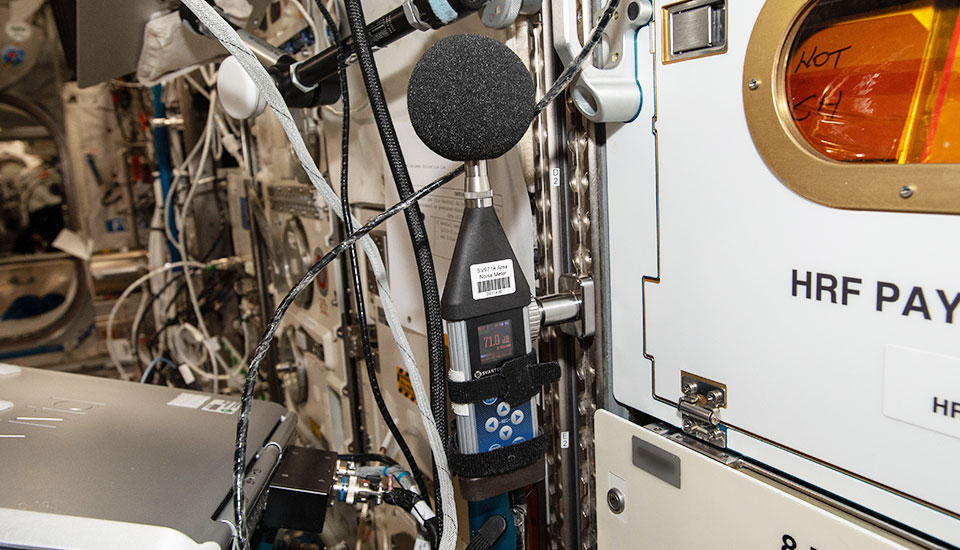
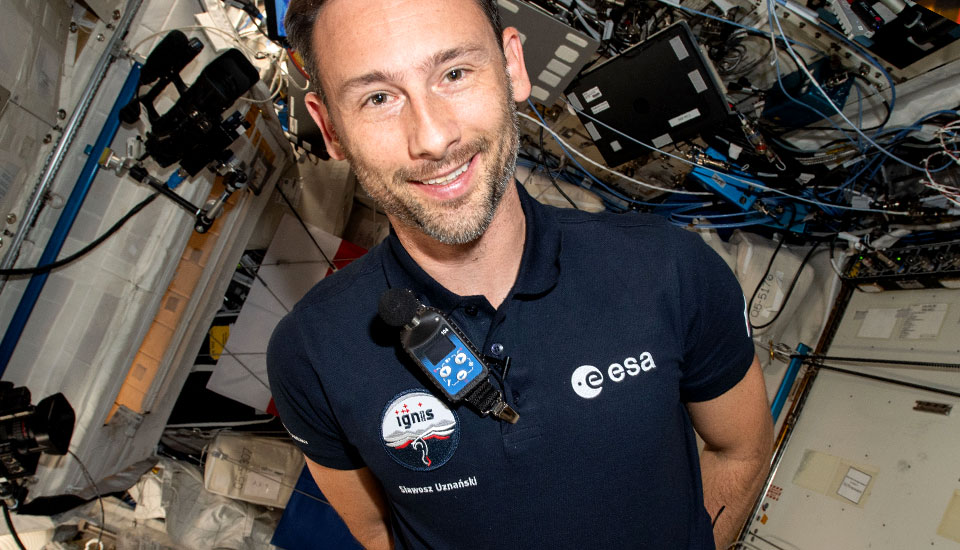
The Wireless Acoustics ISS Technology Demonstration was designed to showcase a new, integrated CHP acoustic monitoring system built around modern hardware. The project introduced two new Svantek devices: the compact SV 971A for fixed-area sound monitoring, and the small,
unobtrusive SV 104A personal dosimeter worn by the crew. The core purpose of the demonstration was to validate the performance, usability, and data integration capabilities of this new hardware in the unique microgravity environment of the ISS, providing a direct comparison against the legacy system.
SV 971A
Class 1 sound level meter on a space station
COPYRIGHT: ESA–S. Uznański-Wiśniewski
SV 104A
Noise dosimeter in operation aboard a space station
COPYRIGHT: ESA–S. Uznański-Wiśniewski
Mission Objectives and Expected Outcomes
The In-Flight Experimental Design
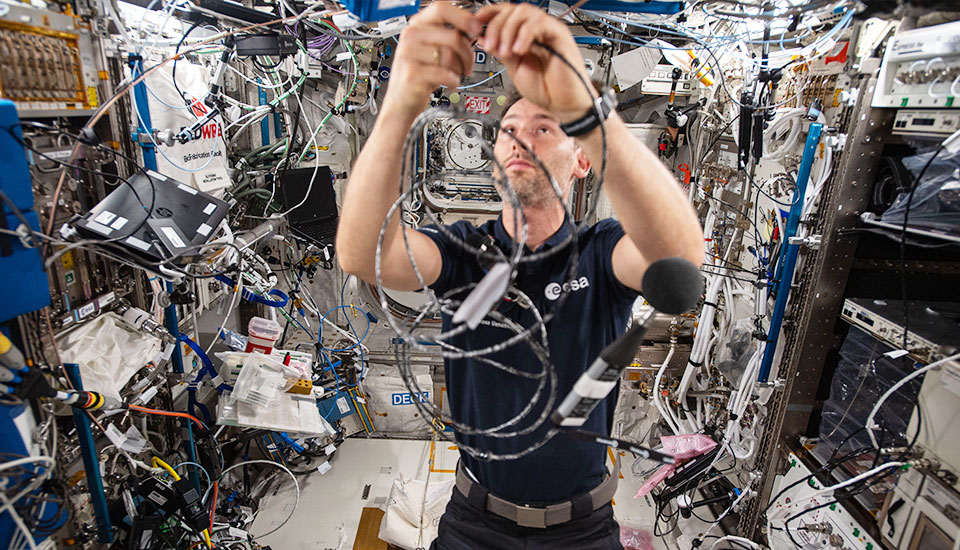
The experiment involved two participating astronauts, each conducting two distinct 24-hour runs to gather comprehensive and comparative data. To ensure crew privacy and data integrity, the devices were configured with a firmware lock that completely disabled their audio recording capabilities, making it impossible to capture any audio. The successful completion of this carefully structured experiment provided a wealth of feedback on the crew’s real-world experience with the new system.
The Astronaut Verdict: A Strong Preference for the New System
Beyond pure technical performance, the success of new spaceflight hardware is heavily dependent on astronaut feedback. Factors like comfort, ease of use, and a low operational workload are essential for a device to be integrated seamlessly into the demanding daily routines of an ISS crew member. The qualitative and quantitative feedback gathered from the detailed NASA-TLX questionnaires completed by the crew provided a clear and decisive verdict.
The feedback for the new SV 104A personal dosimeter was overwhelmingly positive. Both participating astronauts reported very low mental, physical, and temporal demands when using the device, indicating that it did not interfere with their standard activities. Frustration levels were rated as extremely low, suggesting a smooth and intuitive user interaction. Most notably, the astronauts rated the device as highly comfortable, even when worn for extended 24-hour periods and during sleep.
When directly compared to the legacy SV 102A+ dosimeter, the new SV 104A was the clear favourite across all key ergonomic and usability metrics. The fixed SV 971A area monitor also performed well in the crew’s assessment, receiving positive ratings for its ease of mounting, the secureness of its installation, and its simple, straightforward operation.
Technical Validation: Hardware Performance Pre- and Post-Flight
COPYRIGHT: ESA–S. Uznański-Wiśniewski
To be certified for spaceflight, sensitive scientific equipment must prove that its metrological accuracy is not degraded by the launch, operation, and return journey.
A rigorous pre- and post-flight calibration process was conducted at an accredited laboratory to quantify any potential impact of the spaceflight environment on the acoustic instruments.
Both the SV 971A Sound Level Meters and the SV 104A Personal Noise Dosimeters underwent two complete calibration sessions: one in January 2025 before the mission and a second in September 2025 after their return from the ISS. The tests were performed at a
PN-EN ISO/IEC 17025 accredited laboratory according to internationally recognised standards — EN 61672-3 for sound level meters and EN 61252 for personal dosimeters. The comprehensive analysis confirmed that the instruments endured the rigours of spaceflight without any meaningful loss of performance.
- Full Compliance Maintained: Both the SV 971A and SV 104A units successfully passed all periodic tests and met the full requirements of their respective standards both before and after the mission.
- No Systematic Degradation: The ISS environment did not cause any material, systematic degradation in the metrological performance of the instruments. The minor deviations observed between pre- and post-flight measurements were random in nature and remained well within the permissible tolerance limits defined by the standards.
- Key Parameters Remained Stable: Critical performance parameters, including reference frequency checks, level linearity, and dynamic toneburst responses, showed remarkable stability. In one instance, the self-noise level of an SV 971A unit even improved post-flight.
- Mechanical Integrity Confirmed: A post-flight visual evaluation found no mechanical damage to any of the units. The report noted that the instruments returned in “an almost off-the-shelf state,” a testament to both their robust design and the professional handling by the ISS crew.
With the hardware’s stability proven, the final step was to
analyse the crucial acoustic data it collected in orbit.
Data Analysis: Insights from the ISS Acoustic Environment
| Requirement |
Parameter |
SV 102A+ (Astronaut 2) |
SV 102A+ (Astronaut 1) |
SV 104A (Astronaut 2) |
SV 104A (Astronaut 1) |
SV 971A (Astronaut 2) |
SV971A (Astronaut 1) |
| < 70 dBA |
LAeq,24h |
66.66 |
72.20 |
71.78 |
76.41 |
60.00 |
56.79 |
| < 72 dBA (Work) |
LAeq,16h |
68.43 |
74.08 |
73.62 |
77.81 |
61.26 |
57.94 |
| < 62 dBA (Sleep) |
LAeq,8h |
55.86 |
52.22 |
60.48 |
71.31 |
55.94 |
53.29 |
| < 85 dBA |
TWA |
71.44 |
76.98 |
78.10 |
83.00 |
64.80 |
61.60 |
| < 140 dBZ |
LZpeak |
136.00 |
122.12 |
131.53 |
126.61 |
117.27 |
107.98 |
The data confirmed that the absolute peak noise limit of 140 dBZ was never reached during the measurement periods. However, the 125 dBZ “startle limit,” a suggested threshold to avoid sudden, disruptive noises, was exceeded six times.
A critical challenge in a microgravity environment is that accidental bumps or high mechanical vibration can corrupt acoustic data, making it appear louder than it actually is.
The new SV 104A personal dosimeter and SV 971A sound level meter feature a built-in vibration sensor that detects and flags these events. This is a crucial feature for maintaining data quality, as it allows analysts to exclude contaminated measurements from final calculations, aligning with the best-practice recommendations of the ISO 9612 standard for determining
occupational noise exposure.
Frequently Asked Questions (FAQ)