Noise Criteria (NC): The Foundational Metric for Speech Intelligibility
Noise Criteria (NC) is a widely used system for rating the acceptability of indoor
background noise. Its strategic importance lies in its ability to translate a complex noise spectrum into a
single, understandable number that directly relates to the potential for speech interference, making it a foundational tool for acoustic design and assessment.
Defining the Noise Criteria (NC) Method
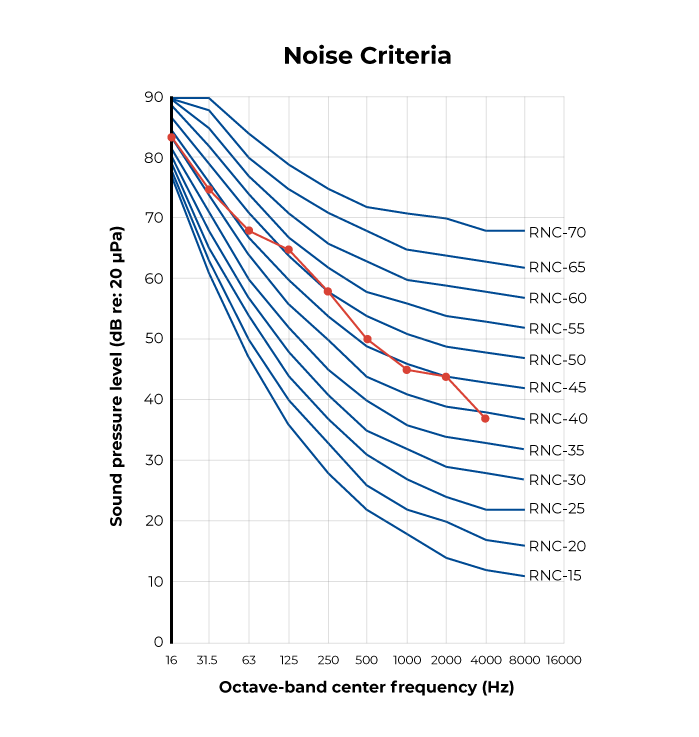
The Noise Criteria method is a system that employs a set of standardised curves to evaluate noise levels across a range of frequencies, specifically from the 63 Hz to the 8000 Hz octave bands. These curves, which are similar to equal-loudness contours, provide a benchmark against which measured background noise is compared. The primary goal is to ensure that the noise spectrum does not mask or interfere with critical activities such as speech communication or create unwanted distractions.
Historical Context and Purpose
Developed by acoustics pioneer Leo Beranek in the late 1950s, the NC system was created primarily in response to growing noise problems from HVAC systems in office buildings. The original intent was to relate the spectrum of a noise source to the disturbance it causes to verbal communication. The NC curves were specifically designed so that their designating number corresponds approximately to the Speech Interference Level (SIL), a measure of how effectively noise masks speech.
The Tangency Method
This is the simplest and most common approach for determining an NC rating. The measured octave-band noise levels are plotted on a graph containing the standard NC curves. The NC rating is then defined by the value of the highest NC curve that is “touched” by any point in the measured spectrum. The frequency band where this touching occurs is always noted along with the rating, e.g., NC-45 (125 Hz).
The Speech Interference Level (SIL) Method
The ANSI/ASA S12.2-2019 standard also describes an alternative method, designated NC-(SIL). This approach uses the Speech Interference Level—calculated as the arithmetic average of the sound pressure levels in the 500, 1000, 2000, and 4000 Hz octave bands—to approximate the NC rating.
While the NC system remains a powerful and widely used tool, its limitations in evaluating the subjective quality of noise, particularly low-frequency rumble, led to the development of a more diagnostic metric: the Room Criteria (RC).
Room Criteria (RC): A Diagnostic Evolution
Room Criteria (RC) represents a significant refinement of the NC method, developed to provide a more nuanced evaluation of indoor background noise. Its strategic importance lies in its ability to assess not only the overall loudness but also the subjective sound quality, diagnosing annoying characteristics such as rumble or hiss that might otherwise go unflagged.
Defining the RC Methodology
Developed in the 1980s by ASHRAE, the RC methodology was a direct response to the shortcomings of the NC method in characterising low-frequency rumble produced by newly energy-efficient HVAC systems. While NC focuses primarily on speech intelligibility, RC was designed to account for both the human ear’s sensitivity and the perceived character of the sound. This makes the RC method more diagnostic, as it provides not only an overall rating but also a characterisation of the tonal balance of the noise.
Components of an RC Rating
An RC rating consists of two parts: a numerical value and a set of letter designations that describe the sound’s character. These descriptors provide valuable diagnostic information about the noise spectrum.
RC Sound Quality Descriptors
- (N) Neutral: The noise has no particular identity with frequency. This is the ideal target for a well-balanced background sound spectrum.
- (R) Rumble: Indicates excessive low-frequency noise. This is flagged when the measured level in one or more octave bands at or below 500 Hz exceeds the reference curve by more than 5 dB.
- (H) Hiss: Indicates excessive high-frequency noise. This is flagged when the measured level in one or more octave bands at or above 1000 Hz exceeds the reference curve by more than 3 dB.
- (RV) Rattle and Vibration: This descriptor identifies low-frequency noise intense enough to cause two distinct phenomena:
- Rattle: The audible sound produced when building components such as light fittings and ceiling tiles are agitated by low-frequency, structure-borne vibrations. This often occurs when noise levels in the 16 Hz to 32 Hz bands exceed a certain threshold.
- Vibration: The perceptible physical sensation felt by occupants through the floor or furniture. This is a physical motion of the building structure itself, typically occurring at frequencies below 20 Hz.
While NC and RC are the predominant systems in the United States, a different standard is widely used internationally.
Noise Rating (NR): The International Standard
Noise Rating (NR) curves serve as the internationally recognised standard for evaluating indoor noise, particularly in the UK, Europe, and other regions outside North America. Like NC, it provides a single-number rating for a broad-spectrum noise, but it is based on a distinct set of criteria.
Defining the NR System
The NR system was developed by the International Organization for Standardization (ISO) and is widely used for specifying and assessing noise in indoor environments. In the UK it is applied through BS EN ISO 1996. It is frequently used to evaluate noise from mechanical ventilation systems in buildings, serving as a key compliance tool in international design and construction projects.
NR Calculation Method
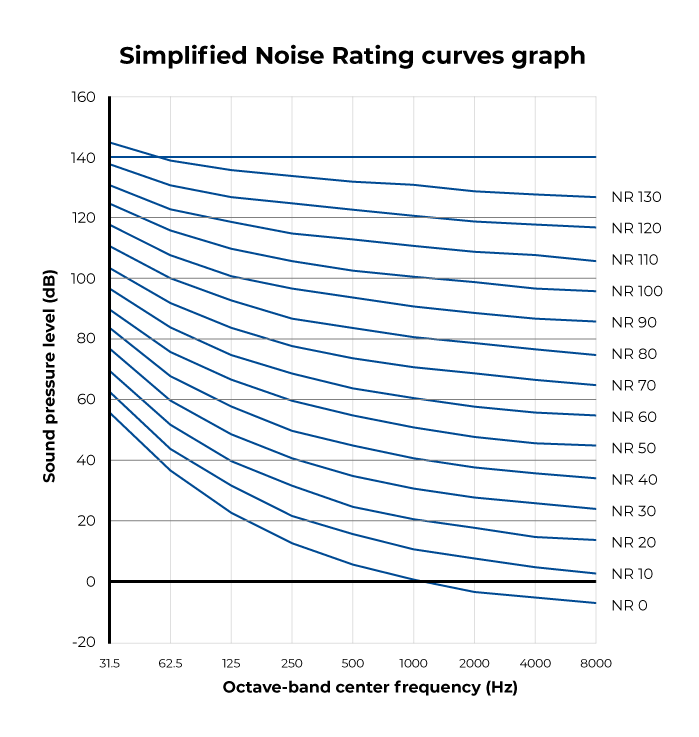
The calculation of an NR value is conceptually similar to the NC tangency method.
Sound pressure levels measured in octave bands are plotted against or compared with a standard set of NR curves. The
final single-number NR value is determined by the highest NR curve that is crossed or “touched” by the measured noise spectrum. Modern sound level meters can perform this calculation automatically.
Critical Distinction from NC
It is crucial for professionals to understand that the NC and NR methods are not interchangeable. They use different sets of curves and will produce different numerical results for the same noise spectrum. Therefore, a rating of NC 30 is not equivalent to NR 30. Specifying the correct metric based on project location and applicable standards is essential.
Beyond these three primary systems, other specialised criteria have been developed to address more acoustically sensitive environments.
Advanced and Specialized Criteria: PNC and RNC
Beyond the primary NC, RC, and NR systems, specialised criteria have been developed to evaluate noise in more demanding or problematic acoustic environments. These tools offer greater stringency and diagnostic capability for specific applications.
Preferred Noise Criterion (PNC)
Preferred Noise Criterion (PNC) curves are an extension of the basic NC system, designed to be more stringent. They are considered superior to NC curves for critical listening environments such as recording studios, concert halls, and lecture theatres. This superiority stems from the fact that PNC curves are less tolerant of low-frequency noise than their NC counterparts, addressing a key area where the original NC system was found to be lacking.
Room Noise Criterion (RNC)
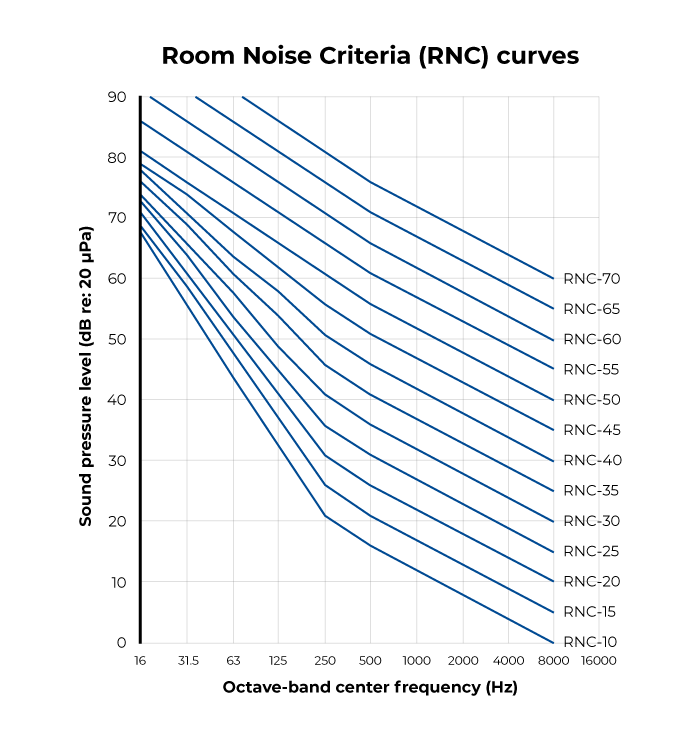
Described in the ANSI/ASA S12.2-2019 standard, the Room Noise Criterion (RNC) method is a specialised tool developed specifically to evaluate environments where low-frequency noise from HVAC systems is high and may contain fluctuations or surging. It essentially functions as a “rumble criterion,” providing a procedure to identify and rate acoustically ill-behaved systems. When systems are well designed, the RNC result is reduced back to a value consistent with the NC curves.
A direct comparison of the main methodologies can help professionals select the most appropriate tool for their specific needs.
Comparative Analysis: Choosing the Right Metric
Selecting the correct noise evaluation metric is a critical decision that depends on the project’s goals, geographic location, and the specific nature of the acoustic challenge. The following table directly compares the key features of Noise Criteria (NC), Room Criteria (RC), and Noise Rating (NR) to guide this selection process.
The comparison highlights the distinct applications of each metric. With a clear understanding of the tools, the next step is conducting accurate measurements.
| Attribute | Noise Criteria (NC) | Room Criteria (RC) | Noise Rating (NR) |
|---|
| Primary Purpose | To rate noise based on its potential to interfere with speech intelligibility. | To evaluate both the level and subjective sound quality of background noise. | To provide a single-number rating for assessing indoor ambient noise levels. |
| Key Differentiator | Focuses on loudness and Speech Interference Level (SIL). | Highly diagnostic, with descriptors for Rumble (R), Hiss (H), and Rattle/Vibration (RV). | An international compliance tool that does not provide detailed diagnostics on spectral balance. |
| Geographical Usage | Primarily used in the USA. | Primarily used in the USA. | Primarily used in Europe and internationally. |
| Governing Body/Origin | Leo Beranek / ANSI | ASHRAE / ANSI | International Organization for Standardization (ISO) |
A Practical Guide to Measurement
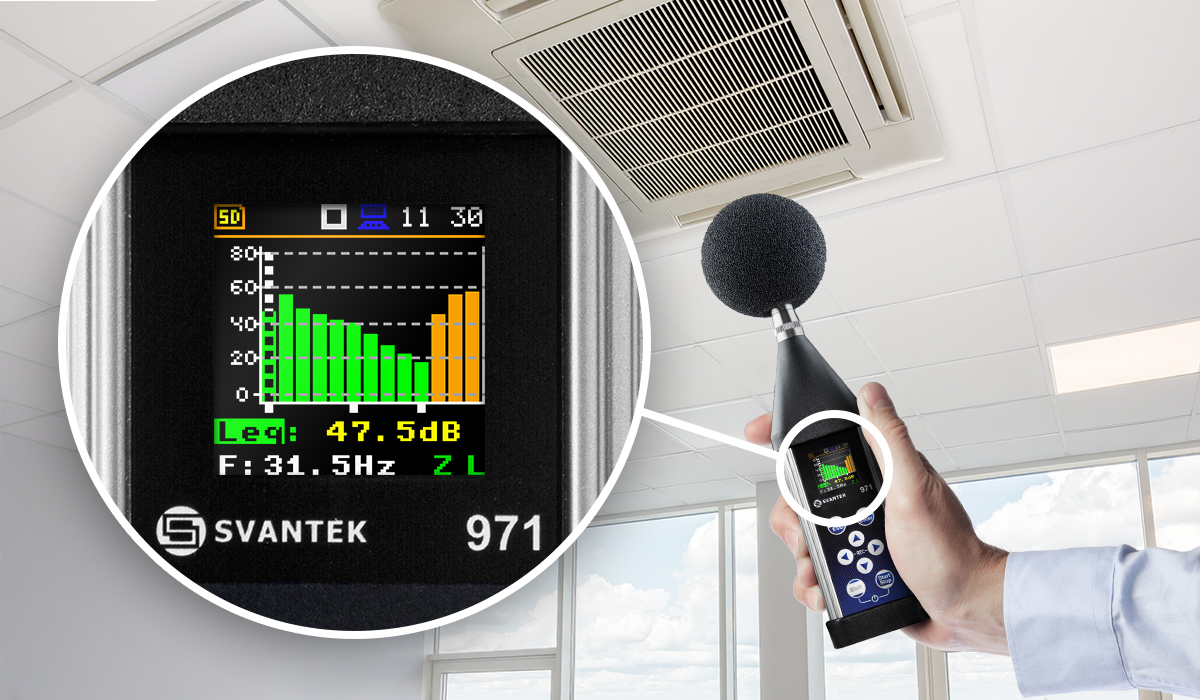
Steps for conducting accurate and standardised indoor noise measurements for NC and RC evaluations:
- Select a Representative Time: Conduct measurements when environmental conditions are typical for the room’s use. For example, ensure the HVAC system is running normally and any typical external noise sources are present.
- Ensure Room is Unoccupied: The room must be empty, with no people present, to avoid conversations or movement from interfering with the ambient background noise measurement.
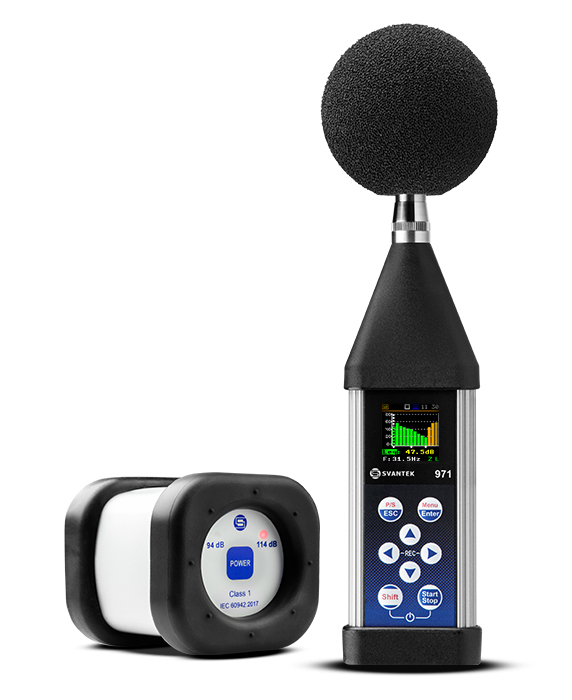
- Calibrate the Instrument: Use the acoustic calibrator to check and adjust the sound level meter’s calibration in the measurement environment both before and after the measurement session.
- Position the Microphone: In line with ANSI/ASA S12.2-2019 and BS EN ISO 1996 guidance, the microphone should be placed at the typical ear height of occupants (e.g., 1.2 metres for seated adults). To avoid reflections that can corrupt data, maintain minimum distances from surfaces: at least 0.6 m from any single reflective surface, 1.2 m from an edge (intersection of two surfaces), and 2.4 m from a corner (intersection of three surfaces).
- Conduct the Measurement: To obtain a representative rating for the space, make several measurements. This can be done by taking readings at multiple fixed locations, particularly in the loudest areas, or by performing a slow scan of the entire room (moving the microphone at no more than 0.5 m/s).
- Set Measurement Duration: The required duration depends on the nature of the noise. For steady-state noise, such as that from a continuously running HVAC system, a period of 15–30 seconds per location is generally sufficient. For fluctuating or intermittent noise, a longer period of 5–15 minutes or more is necessary to capture the variations over time.
- Once the data is collected, the final step is to compare it against established standards and recommendations for the specific type of space.
Required Equipment
Application Standards and Recommended Levels
The ultimate purpose of measuring indoor ambient noise is to compare the results against established criteria for specific room types. These benchmarks, provided by industry standards, help ensure that the acoustic environment is suitable for its intended function.
Recommended NC, RNC, and RC Levels (ANSI/ASA S12.2-2019)
The following table provides a selection of recommended noise criteria for various unoccupied rooms as specified in the ANSI/ASA S12.2-2019 standard.
| Type of Room/Space | Recommended NC and RNC Curve | Recommended RC Mark Criteria |
|---|
| Bedrooms | 25–30 | 25–30(N) |
| Executive Offices | 25–35 | 25–35(N) |
| Open-Plan Offices | 35–40 | 30–40(N) |
| Conference Rooms (Large) | 25–30 | 25–35(N) |
| Hospitals (Private Rooms) | 25–30 | 25–35(N) |
| Hospitals (Wards) | 30–35 | 30–40(N) |
| Classrooms (< 566 m³) | 25–30 | 25–30(N) |
| Live Performance Theaters | 20–25 | — |
Recommended NR Levels (ISO)
The following table outlines maximum recommended Noise Rating (NR) levels for various applications, commonly used in Europe and internationally.
| Noise Rating (NR) Level | Application |
|---|
| NR 25 | Concert halls, broadcasting and recording studios, churches |
| NR 30 | Private dwellings, hospitals, theatres, cinemas, conference rooms |
| NR 35 | Libraries, museums, court rooms, schools, hotels, executive offices |
| NR 40 | General offices, restaurants, halls, corridors, shops |
| NR 60 | Light engineering works |
| NR 70 | Foundries and heavy engineering works |
Key Principles for Effective Noise Evaluation
The most critical principle is to recognise that these noise curves move beyond simple loudness measurement to a more nuanced evaluation that considers frequency content and its impact on human comfort, communication, and productivity.
Effective noise management requires selecting the appropriate metric for the task. Whether using the foundational NC for speech intelligibility, the diagnostic RC to assess sound quality, or the international NR standard for global projects, the choice must be informed by the specific goals of the project, its location, and the nature of the noise being evaluated.