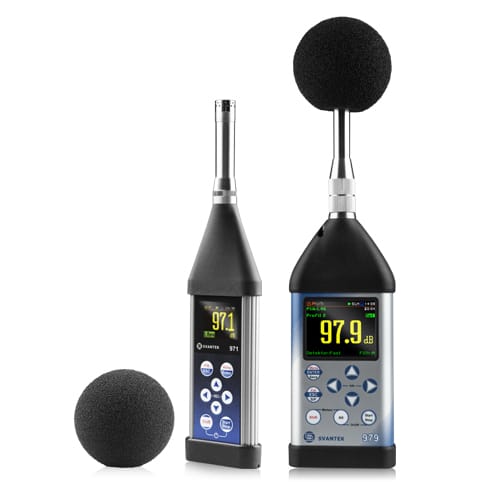
Noise coming from bathrooms of neighboring premises is most often generated by water flowing in the sewage system, toilet flushes, turning on water in sinks, showers and bathtubs, as well as the operation of rain showers and hydromassage systems. In most cases, noise measurements from neighboring bathrooms are used to assess the level of sounds generated by these installations and the sound insulation of the walls between apartments, which allows you to check whether the noise level is within the permissible acoustic standards.
Noise measurements from bathrooms of neighboring premises are carried out when the noise becomes annoying and exceeds comfortable levels. Thanks to professional measurements, it is possible to check whether the noise exceeds the permissible standards, which allows residents to claim and obtain compensation in the event of a violation of the regulations. Additionally, it is worth assessing the sound insulation of the walls to ensure that they meet building standards for noise protection.
Noise and insulation measurements of bathrooms are best outsourced to accredited laboratories, which guarantees precise and reliable results. Due to the peculiarities of each apartment, the measurements must be properly adapted to the conditions of the premises. Thanks to the experience of specialists, the measurements are carried out in accordance with the highest standards, and accreditation ensures that the measurement report can be used in legal proceedings, which gives confidence in the correctness of the process.To reduce the level of noise from roads, highways and railroads, upgrades and renovations are often necessary. Noise barriers are also a very good tool for combating traffic noise. All of these solutions do not guarantee total noise reduction. It is often necessary to act on many levels. The starting point for any work is acoustic maps of areas. To be able to win the battle against noise, we must first identify the noise.
While the EU’s Environmental Noise Directive provides a framework for assessing and managing environmental noise, specific permissible noise levels and sound insulation requirements are determined by individual Member States. These national regulations often reference international guidelines, such as those from the WHO, to define acceptable noise levels in various environments, including residential buildings.
For example, in Poland, in the case of noise coming from a neighbor’s bathroom, the insulation of the wall between the apartments is considered. The wall is required to achieve an R’A1 index (a single-number rating of apparent airborne sound insulation, including the spectrum adaptation term C) of at least 50 dB.
In addition, the sound level in the receiving room is assessed in accordance with PN-B-02151-2, “Building Acoustics – Protection Against Noise in Buildings – Permissible Sound Levels in Rooms.” These limits typically range from 25–30 dB at night and 35–40 dB during the day.