


Understanding the Exchange Rate is critical for accurately assessing occupational noise exposure, yet it remains the most common source of confusion for safety professionals. This difficulty arises because regulations are often written in dense legal/technical language that obscures the practical implications.
The exchange rate defines the mathematical relationship between increasing noise dosage in decibels and the corresponding reduction in allowable workplace exposure duration.
It answers the question: How many decibels must the noise level increase to halve the safe exposure time?
The exchange rate is essentially a doubling rate that dictates the relationship between sound levels and allowable duration (time).
A worker completing a 4-hour task at 90 dBA would reach only 50% of their daily OSHA dose but would significantly exceed the maximum safe duration under the NIOSH 3 dB standard.
Physics dictates that sound energy doubles with every 3 dB increase. Therefore, scientific consensus (backed by NIOSH, ISO, and EU standards) utilizes a 3 dB exchange rate. In its Criteria for a Recommended Standard (Publication 98-126), NIOSH provides three pillars of evidence justifying this approach:
The National Institute for Occupational Safety and Health (NIOSH), the ACGIH, and the European Union (EU) recommend the 3dB exchange rate based on scientific evidence, setting a Recommended Exposure Limit (REL) of 85 dBA. This distinction positions the 5dB rate as a minimum regulatory threshold, while the 3dB rate represents a stricter, health-centric standard used by most international agencies .
OSHA and MSHA mandates utilize a 5 dB exchange rate.
The Occupational Safety and Health Administration (OSHA) and the Mine Safety and Health Administration (MSHA) enforce the 5dB exchange rate for General Industry and mining operations, respectively . This framework establishes the Permissible Exposure Limit (PEL) at 90 dBA TWA (8-hour) and sets an Action Level at 85 dBA TWA, which triggers the Hearing Conservation Amendment requirements such as monitoring and training .
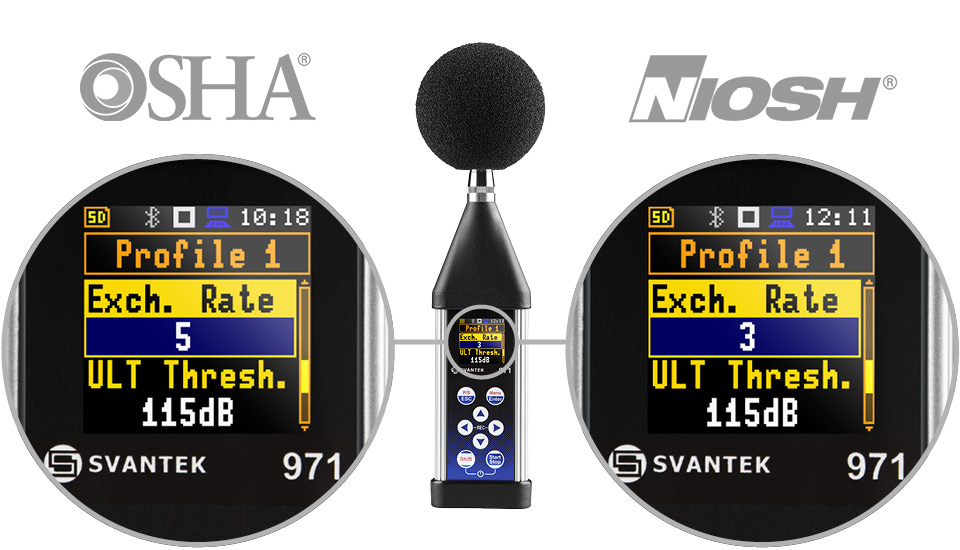
The US regulatory standard diverges from the global consensus on the 3dB vs. 5dB exchange rate largely due to the persistence of historical regulatory frameworks like the Walsh-Healey Public Contracts Act. While international bodies and standards such as ISO 1999:2013 and ANSI S1.25 adopt the “Equal Energy Rule” to minimize the risk of material impairment, the US approach incorporates economic feasibility and “dose-trading” relations into its legislation.
The Environmental Protection Agency (EPA) and NIOSH data highlight the health implications of this divergence: the excess risk of material hearing impairment over a working lifetime is estimated at 8% under the 85 dBA limit (3dB rule), compared to a 25% risk under the 90 dBA limit (OSHA 5dB rule). Consequently, the 5dB rate is retained in US jurisdiction primarily for compliance feasibility rather than for its alignment with modern feasible engineering controls or health outcomes .
The scientific accuracy of the 3dB exchange rate is predicated on the “Equal Energy Principle,” which asserts that the total energy of sound is the primary predictor of hearing damage. Because the decibel scale is logarithmic, a 3dB increase in Sound Pressure Level (SPL) represents a mathematical doubling of acoustic energy. Therefore, the allowable exposure duration must be halved to maintain a constant integrated sound energy dose, preventing the simple averaging of noise levels that would underestimate risk. ISO 1999 and physics-based models support this Equal Energy Concept as the only accurate method for hearing loss estimation in continuous noise environments .
The 5dB exchange rate is grounded in the theory that intermittent noise is less damaging than continuous noise due to the ear’s ability to recover during quiet intervals. The OSHA Technical Manual and historical data suggest that these “rest periods” reduce the cumulative effect of the Temporary Threshold Shift (TTS), thereby justifying a “exchange rate factor” that halves exposure only every 5dB . This approach essentially provides a “leniency” factor for fluctuating noise, assuming that administrative controls and auditory recovery will mitigate the higher peak levels.
Permissible Shift Lengths at 90 dBA:
This means a worker completing a 4-hour task at 90 dBA would reach only 50% of their daily OSHA dose but would significantly exceed the maximum safe duration under the NIOSH 3 dB standard, requiring strict administrative controls and shift rotation to maintain a healthy work environment.
At 100 dBA noise levels, the operational difference between the 3 dB and 5 dB exchange rates creates an 800% disparity in allowable work time.
As of 2026, the specific differences are as follows:
This severe restriction under the 3 dB standard necessitates strict administrative controls and shift rotations for tasks involving heavy machinery or pneumatic tools that generate 100 dBA. For comparison, OSHA only restricts exposure to 1 hour once noise levels reach 105 dBA.
| Duration per day, hours | Sound level dBA slow response |
|---|---|
| 8 | 90 |
| 6 | 92 |
| 4 | 95 |
| 3 | 97 |
| 2 | 100 |
| 1½ | 102 |
| 1 | 105 |
| ½ | 110 |
| ¼ or less | 115 |
| Exposure Level (dBA) | Hours | Minutes | Seconds |
|---|---|---|---|
| 80 | 25 | 24 | — |
| 81 | 20 | 10 | — |
| 82 | 16 | — | — |
| 83 | 12 | 42 | — |
| 84 | 10 | 5 | — |
| 85 | 8 | — | — |
| 86 | 6 | 21 | — |
| 87 | 5 | 2 | — |
| 88 | 4 | — | — |
| 89 | 3 | 10 | — |
| 90 | 2 | 31 | — |
| 91 | 2 | — | — |
| 92 | 1 | 35 | — |
| 93 | 1 | 16 | — |
| 94 | 1 | — | — |
| 95 | — | 47 | 37 |
| 96 | — | 37 | 48 |
| 97 | — | 30 | — |
| 98 | — | 23 | 49 |
| 99 | — | 18 | 59 |
| 100 | — | 15 | — |
| 101 | — | 11 | 54 |
| 102 | — | 9 | 27 |
| 103 | — | 7 | 30 |
| 104 | — | 5 | 57 |
| 105 | — | 4 | 43 |
| 106 | — | 3 | 45 |
| 107 | — | 2 | 59 |
| 108 | — | 2 | 22 |
| 109 | — | 1 | 53 |
| 110 | — | 1 | 29 |
| 111 | — | 1 | 11 |
| 112 | — | — | 56 |
| 113 | — | — | 45 |
| 114 | — | — | 35 |
| 115 | — | — | 28 |
| 116 | — | — | 22 |
| 117 | — | — | 18 |
| 118 | — | — | 14 |
| 119 | — | — | 11 |
| 120 | — | — | 9 |
| 121 | — | — | 7 |
| 122 | — | — | 6 |
| 123 | — | — | 4 |
| 124 | — | — | 3 |
| 125 | — | — | 3 |
| 126 | — | — | 2 |
| 127 | — | — | 1 |
| 128 | — | — | 1 |
| 129 | — | — | 1 |
| 130–140 | — | — | < 1 |
Yes, adopting the 3 dB exchange rate typically requires stronger hearing protection in occupational settings. This is because the 3 dB rule (used by NIOSH) attributes significantly more sound energy to high-intensity noise peaks compared to the OSHA 5 dB rule. In variable noise environments, this results in a higher calculated average exposure level (Lavg or LAeq), which then mandates the use of Hearing Protection Devices (HPDs) with a higher Noise Reduction Rating (NRR) to adequately reduce the employee’s exposure below safe action levels (85 dBA TWA). Furthermore, best practices involve heavily “derating” the NRR of HPDs—by 25% for earmuffs and 50% for earplugs—further increasing the necessary labeled NRR for effective protection.
The 3dB standard (commonly associated with the National Institute for Occupational Safety and Health – NIOSH) offers better long-term hearing preservation compared to the 5dB standard (associated with the Occupational Safety and Health Administration – OSHA) because it is a stricter metric for allowable noise exposure over a working lifetime. The 3dB standard utilizes a more conservative “equal energy” exchange rate, meaning that for every 3 decibel increase, the allowable exposure time is halved, effectively limiting chronic exposure and reducing the cumulative energy dose to the ear. This stricter approach results in a significantly lower excess risk of developing occupational noise-induced hearing loss (8% risk at 85 dBA under the 3dB standard versus 25% risk at 90 dBA under the 5dB standard), thereby facilitating earlier intervention and more effective health surveillance.
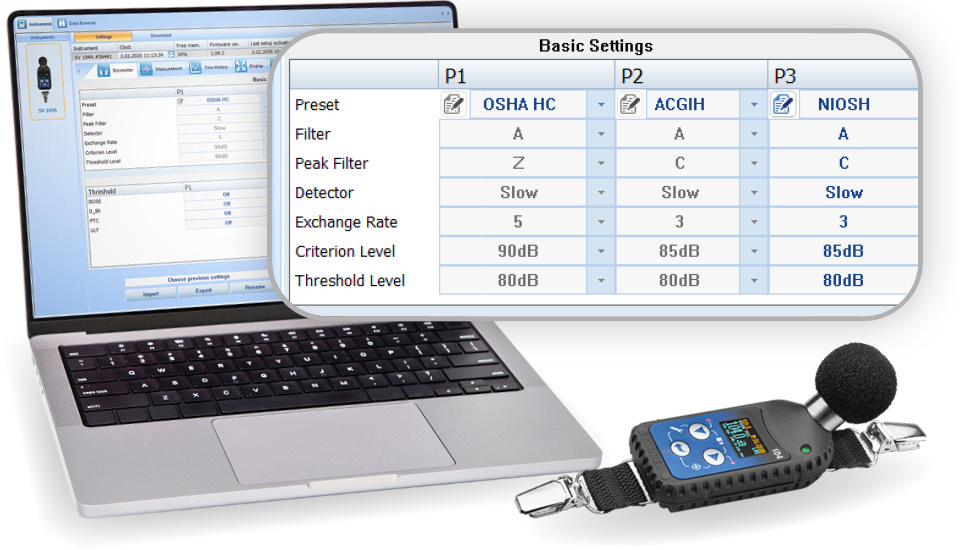
Recognizing this regulatory complexity, equipment manufacturers (e.g., Svantek) design modern dosimeters to measure multiple profiles simultaneously. This allows safety professionals to run parallel measurements—capturing legally mandated OSHA data (5 dB) while concurrently recording scientific NIOSH or EU data (3 dB) in a single session—eliminating the need to choose between compliance and best practices.
An authorized SVANTEK consultant will help You with the details such as the required accessories for your noise monitoring task.