
Sound Insulation Testing
In building standards, sound insulation refers to the capacity of a separating partition to resist the passage of airborne or impact noise. This performance value is calculated for specific building elements, including separating walls, floors, doors, and windows, to ensure compliance with the building regulations.
Noise Mitigation and Compliance
UK Building Regulations mandate that dwellings are designed to protect occupants from noise levels that may affect health and sleep. To achieve this, designers and contractors must adhere to specific performance standards and noise limits. The regulations address three primary sources of noise: external environmental noise, mechanical building services and equipment, and sound transmission from adjacent properties. Compliance ensures that the internal environment remains safe, comfortable, and fit for habitation.
Acoustic Design Requirements
Resistance to the Passage of Sound (Approved Document E) is the official UK government guidance used to satisfy the acoustic requirements of the Building Regulations in England and Wales. It specifies the minimum performance standards for sound insulation in new builds, conversions, and school buildings.
To satisfy Approved Document E, internal and external building elements must meet specific acoustic insulation thresholds. This requires airborne sound insulation for external facades, windows, and doors, as well as internal walls and floors. Furthermore, floors must provide both airborne and impact sound insulation to prevent noise transfer between dwellings. Adhering to these specifications allows designers and contractors to ensure a quiet, habitable environment that meets mandatory performance standards.
Primary Acoustic Standards and Guidance
The primary regulatory framework for acoustic insulation in England and Wales is Approved Document E of the Building Regulations, which sets mandatory minimum performance levels for sound resistance. Beyond this legal requirement, several British and International Standards provide technical guidance and measurement protocols:
- BS 8233:2014: This British Standard provides a code of practice for noise reduction and sound insulation. It outlines recommended indoor ambient noise levels for different room types, such as 30 dB for bedrooms at night to ensure healthy sleep.
- Building Bulletin 93 (BB93): Issued by the Department for Education, this standard defines the acoustic performance required for schools. It addresses specific needs like speech intelligibility, reverberation times, and sound insulation between classrooms.
- BS EN ISO 717: This series of standards defines the methods for rating airborne and impact sound insulation in buildings and of building elements using single-number quantities.
- BS EN ISO 10140: Used for laboratory measurement of sound insulation, this standard specifies how building elements like walls and floors are tested under controlled conditions.
Acoustic Testing and Compliance
Sound insulation measurements verify that a building meets the mandatory performance standards set out in Approved Document E. Failure to achieve these levels can expose occupants to intrusive noise from adjoining properties, mechanical services, or the external environment, which significantly impacts health, sleep quality, and general well-being. By conducting Pre-Completion Testing (PCT), developers ensure that partitions provide sufficient resistance to sound, confirming that the finished construction delivers a compliant, quiet, and habitable living space.
When measure noise insulation?
Sound insulation testing is conducted at the pre-completion stage, when building work is substantially finished but before residents move in. It is mandatory for most new-build residential properties and buildings undergoing a material change of use, such as conversions into flats. While these standards apply to dwellings and schools, buildings with specialist acoustic requirements—including hospitals, music studios, and testing laboratories—are governed by separate technical guidance.
Airborne and Impact Sound Transmission
Acoustic insulation accounts for both airborne and impact sound to prevent noise nuisance within buildings. Airborne sound, such as conversation, music, or television, propagates directly through the air and is resisted by the mass and airtightness of partitions. Impact sound, often referred to as structure-borne noise, is generated by physical contact with a building element—common examples include footsteps, slamming doors, or mechanical vibrations from lifts and ventilation systems. Although these vibrations travel through the building’s structural frame, they are ultimately radiated as airborne sound into habitable rooms, necessitating the use of resilient layers and isolated structures to meet mandatory Building Regulation standards.
Reporting Acoustic Performance
The acoustic insulation is presented using standardized single-number ratings expressed in decibels (dB). These values differ depending on whether the measurement was conducted in a laboratory or on a live construction site:
- Laboratory Ratings (RW): The Weighted Sound Reduction Index represents the performance of a specific material or component (like a door or window) tested under ideal conditions.
- On-Site Airborne Ratings (DnTW+Ctr): Used for separating walls and floors, this represents the Weighted Standardized Level Difference. The Ctr term is a correction factor that accounts for low-frequency noise, such as urban traffic. A higher figure indicates better insulation.
- On-Site Impact Ratings (L’nT,W): Used for floors, this measures the Weighted Standardized Impact Sound Pressure Level. Because this measures how much noise reaches the room below, a lower figure indicates better performance.
What are the requirements for doors in residential buildings?
In accordance with Approved Document E, internal doors within residential buildings must achieve a minimum weighted sound reduction index of 29 dB RW to ensure adequate privacy between habitable rooms and common areas. These requirements are mandatory for entrance doors to flats and rooms for residential purposes.
Impact Sound Measurement Procedures
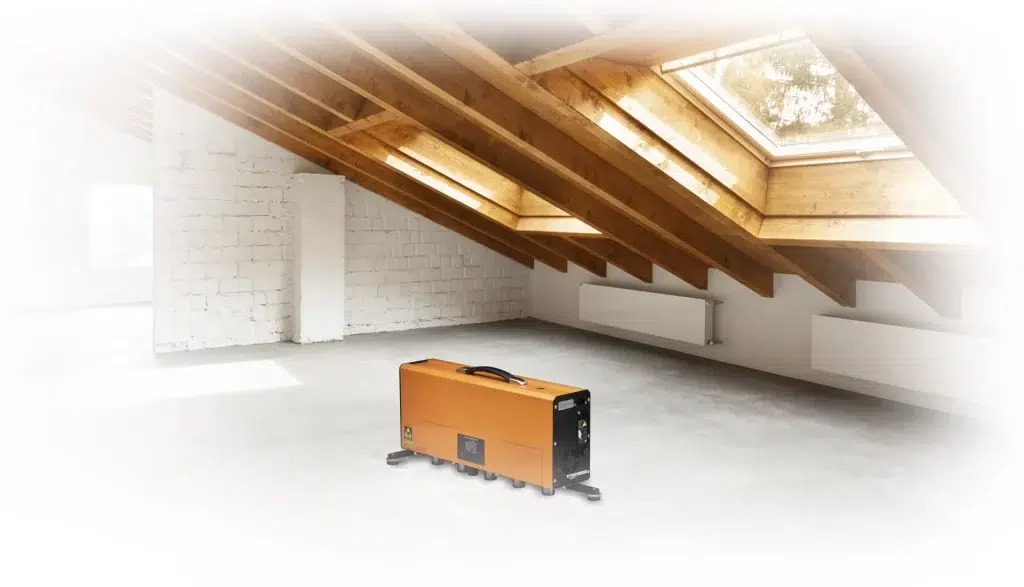
To measure impact sound insulation in accordance with Approved Document E, a standardized tapping machine is used to physically excite the separating floor. This machine features five calibrated hammers that strike the floor surface at a consistent rate of 10 times per second, simulating real-world impacts such as footsteps. A Class 1 sound level meter then records the resulting sound pressure levels in the room directly below, typically across third-octave bands ranging from 100 Hz to 3150 Hz.
The final performance rating, known as the Weighted Standardized Impact Sound Pressure Level (L’nT,W), is calculated by adjusting the raw data for background noise and the reverberation time of the receiving room. For new-build dwellings, the recorded value must be 62 dB or lower, while conversions are permitted a slightly higher limit of 64 dB. To ensure accuracy, the tapping machine must be placed in at least four different positions, with a minimum of six measurements taken across the floor area.
Airborne Sound Measurement Procedures
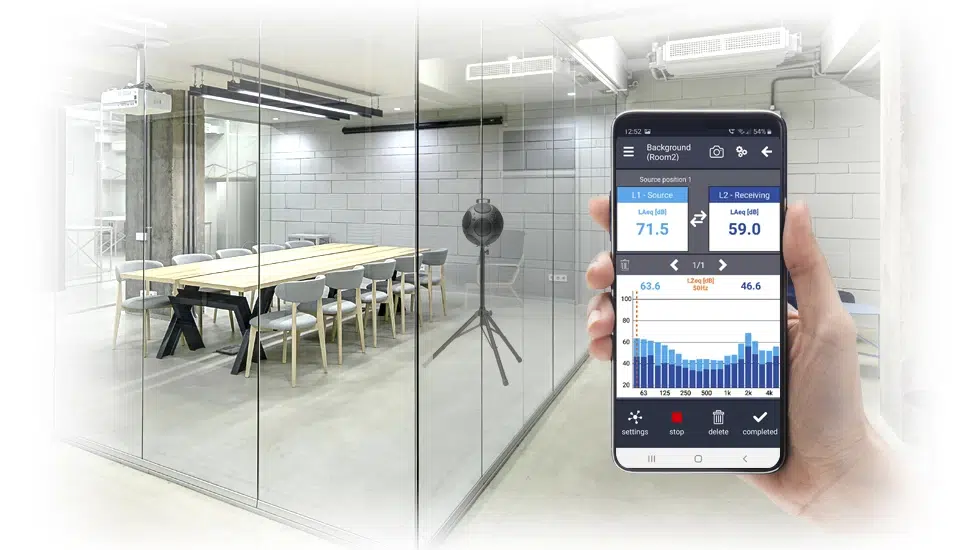
To measure airborne sound insulation, a high-output omnidirectional loudspeaker is used to generate a consistent “pink noise” signal in a source room. Using a Class 1 sound level meter, acoustic consultants measure the average sound pressure levels in both the source room and the adjacent receiving room across a frequency range of 100 Hz to 3150 Hz. The difference between these levels represents the raw noise reduction provided by the separating partition.
The final performance rating, expressed as DnT,W, is determined by correcting the results for the reverberation time of the receiving room and applying a low-frequency traffic noise correction factor (Ctr). For new-build houses and flats, the separating walls and floors must achieve a minimum value of 45 dB, while a lower threshold of 43 dB is permitted for rooms created by a material change of use. These measurements ensure that the partition effectively resists common airborne noises such as speech, television, and music.
SITMA-Approved Svantek Equipment
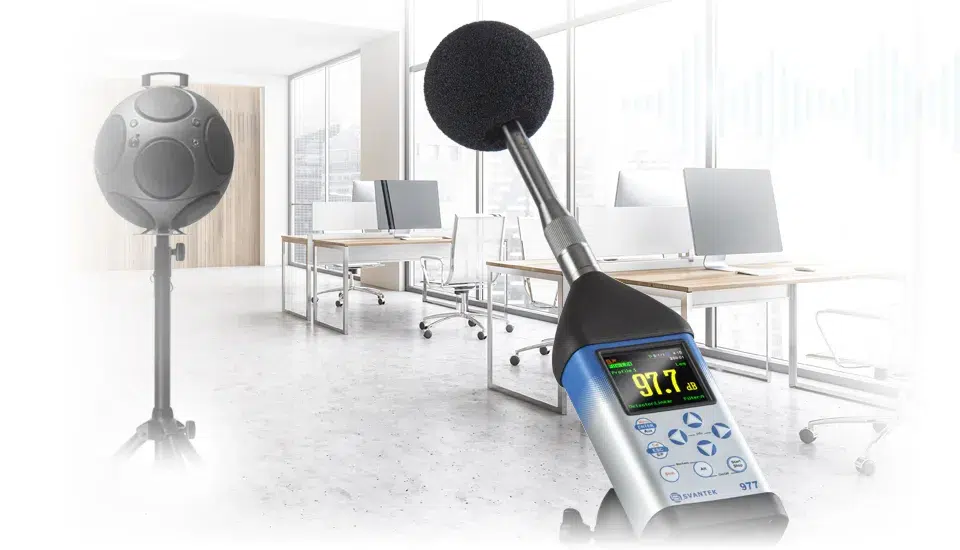
Under the SITMA (Sound Insulation Testing & Measurement Association) scheme, all measurement equipment must meet Class 1 precision standards to be valid for Building Regulations compliance. Svantek provides several instruments that are fully approved for on-site measurements:
- Sound Level Meters: The SV 971A, SV 977D, and SVAN 979 are Class 1 instruments that support the required 1/3 octave band analysis and reverberation time (RT60) calculations.
- Software Integration: Svantek’s Building Acoustics PRO app is specifically approved by SITMA for performing on-site calculations and generating reports that comply with ISO 16283 and Approved Document E.
- Acoustic Calibrators: To maintain SITMA accreditation, meters must be verified before and after each test using a Class 1 calibrator, such as the SV 33B or SV 36.
- Impact Sources: For floor testing, the Tapping Machine or the SP 95 Impact Ball (for lightweight structures) are used to generate the necessary impact noise.
To remain compliant, all Svantek meters must undergo laboratory calibration every two years, while calibrators require annual certification