Building Acoustics
Building acoustics in the UK focuses on the scientific control of sound within and around structures to ensure occupant comfort and functional suitability. Key areas of concern include sound insulation, which addresses the resistance to noise passing through separating walls and floors, and room acoustics, which deals with the behaviour of sound within an internal space. These principles are essential for managing both airborne sound, such as speech or music, and impact sound, such as footsteps or falling objects, to maintain privacy and reduce disturbance.
Compliance is primarily governed by Approved Document E of the Building Regulations, which sets mandatory minimum performance standards for dwellings, schools, and residential buildings. For example, new-build residential partitions must achieve at least 45 dB of airborne sound insulation to be considered compliant. Beyond regulatory mandates, design guidance such as BS 8233:2014 provides a framework for controlling external noise ingress and internal reverberation to create appropriate acoustic environments for various building uses.
Professional Definition of Building Acoustics
Building acoustics is a specialised branch of architectural acoustics focused on managing sound within the built environment. It specifically addresses how sound waves propagate in enclosed spaces and the effectiveness of sound insulation across various building partitions, such as walls, floors, and ceilings. This field of study aims to control sound reflections and absorption to ensure high-quality acoustic performance and occupant comfort. By optimising factors such as reverberation time and sound transmission class (STC), building acoustics ensures that structures are fit for their intended purpose, whether as quiet residential spaces or clear learning environments in schools
Principles of Sound Insulation
Sound insulation refers to the capacity of a building element—such as a wall, floor, or ceiling—to resist the passage of noise between separate spaces. This performance is categorised into two distinct types:
- airborne insulation, which blocks sounds travelling through the atmosphere like speech or music,
- impact insulation, which reduces the transmission of physical energy from objects striking the structure, such as footsteps or falling items.
The primary objective is to maintain acoustic privacy and comfort by ensuring that sound energy is either reflected or absorbed by the partition rather than being transmitted into an adjacent room.
The legal requirements for sound insulation in the UK are defined by Approved Document E of the Building Regulations, which specifies minimum decibel (dB) reduction targets for different types of construction. For instance, a new-build separating wall must achieve an airborne sound insulation value of at least 45 dB, while a floor must also limit impact sound transmission to no more than 62 dB. These standards ensure that partitions are sufficiently robust to mitigate the “nuisance” of everyday noise in residential, educational, and healthcare settings.
Understanding Reverberation and Internal Noise
The reverberation is defined as the persistence of sound in an enclosed space after the original source has stopped. This occurs because sound waves reflect off hard internal surfaces—such as plastered walls, concrete floors, and glazing—as well as objects within the room. In building acoustics, this reflected energy is often referred to as reverberant noise, which contributes to the overall ambient sound level and can significantly degrade speech intelligibility and acoustic comfort. If surfaces are too reflective, the sound “rings” or echoes, leading to high reverberation times that make environments like classrooms or offices difficult to use.
To manage this, designers must incorporate sound-absorbing materials, such as acoustic ceiling tiles or wall-mounted panels, to dissipate sound energy rather than reflecting it. By reducing the reverberation time RT60, the “build-up” of noise is minimised, ensuring that the internal environment remains functional and meets UK statutory health and safety standards for occupant wellbeing.
Definition of Reverberation Time
Reverberation time, RT60, is the time required for the sound pressure level in an enclosed space to decay by 60 decibels after the source of the sound has stopped. It is a fundamental metric in building acoustics used to quantify the “echo” or persistence of sound within a room. This parameter is critical for determining the acoustic suitability of a space; a high reverberation time typically results in a “boomy” environment where speech is difficult to understand, whereas a low reverberation time creates a “dry” or acoustically dead space.
For example, a standard primary school classroom generally requires a reverberation time of less than 0.6 seconds to ensure clear communication between teachers and students. Conversely, larger managed spaces like entrance halls or open-plan offices may have higher allowances, provided they do not cause excessive noise build-up or acoustic interference.
Understanding Acoustic Absorption
Acoustic absorption refers to the ability of a surface, object, or the air itself to dissipate sound energy, preventing it from reflecting back into a room. It is a calculated value based on the absorption coefficients of all internal boundary surfaces—such as acoustic ceiling tiles, carpets, and wall panels—as well as the volume of air and any furniture present. This parameter is fundamental to controlling reverberation and ensuring that internal spaces do not become excessively noisy or “echoey.”
Absorption is typically assessed across the mid-frequency octave bands of 500 Hz, 1000 Hz, and 2000 Hz. These frequencies are critical for speech intelligibility and represent the “mid-frequency reverberation time”. By specifying materials with high absorption ratings (such as Class A or B absorbers), designers can effectively reduce noise build-up and meet the mandatory acoustic requirements for schools, hospitals, and residential common areas.

Common Noise Sources in Buildings
Noise sources in the built environment are generally categorised by their origin and how they travel through a structure.
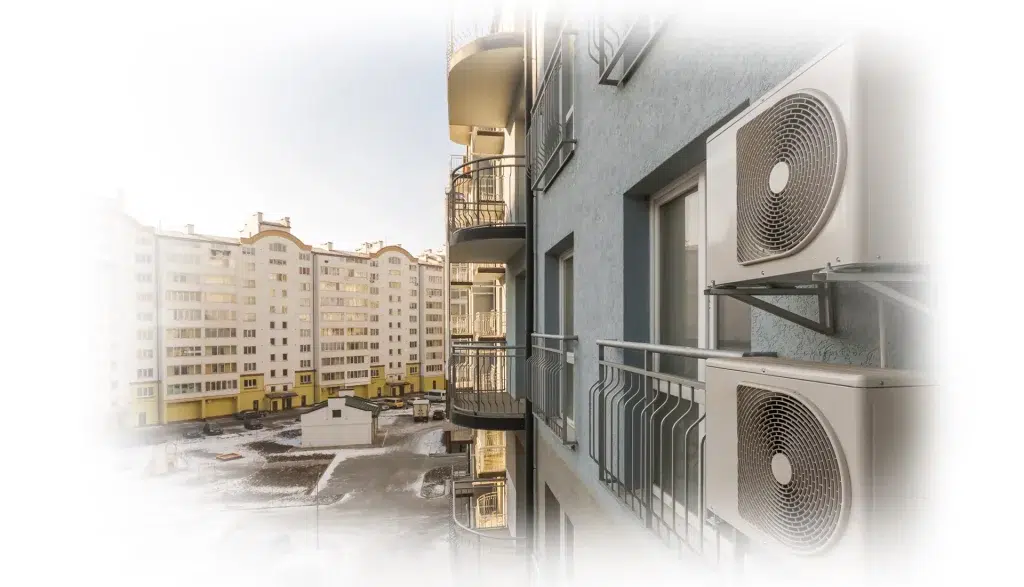
- External noise frequently enters through “weak links” in the building envelope, such as windows, doors, and air bricks. Primary sources include road traffic, rail networks, and aircraft, alongside industrial activity or mechanical installations like external air conditioning units. In urban areas, ground-borne vibration from heavy vehicles or underground trains can also transfer energy directly into a building’s foundations, manifesting as audible low-frequency noise.
- Internal noise originates from within the building and is split between airborne and impact sources. Airborne noise includes speech, music, and television audio, while impact noise refers to physical contact with the structure, such as footsteps on a floor or moving furniture. Additionally, building services—including lift motors, plumbing in transit, and ventilation ducting—can create persistent background hums or intermittent mechanical sounds.
How does sound propagate in buildings?
Sound travels through buildings via two primary transmission paths: airborne and impact.
- Airborne sound originates from sources that vibrate the air directly, such as speech, television audio, or musical instruments. This energy propagates through open spaces and can penetrate building elements like walls or ceilings. In contrast, impact sound is generated by the physical vibration of the building’s fabric itself. Common examples include footsteps on a floor, slamming doors, or the mechanical operation of lifts and ventilation systems.
- Impact noise is particularly challenging as it travels efficiently through the building’s structural frame, often bypassing simple partitions via flanking transmission.
To ensure acoustic comfort and meet UK regulatory standards, designers must address both paths by using dense materials to block airborne noise and resilient layers to decouple structural elements, thereby dampening impact energy before it becomes audible.
Recommended Internal Noise Levels
In the UK, permissible internal noise levels are primarily guided by BS 8233:2024, which categorises acceptable ambient sound levels based on a building’s function.
- For residential environments, the standard recommends a maximum equivalent sound level LAeq of 30 dB in bedrooms at night (23:00–07:00) to ensure undisturbed sleep, and 35 dB in living rooms during the day (07:00–23:00) for resting. These targets are often adopted by local planning authorities as mandatory conditions for new developments. In more sensitive settings like hospitals, similar stringent limits apply to wards to aid patient recovery, while dining rooms and less critical areas have a slightly higher threshold of 40 dB.
- For public and commercial spaces where higher activity levels are expected, the recommended thresholds are naturally increased. British Standards and WHO guidelines suggest that spaces such as open-plan offices, department stores, and supermarkets can operate effectively with background noise levels ranging from 45 dB to 50 dB. High-energy environments like gyms or indoor swimming pools typically fall at the upper end of this spectrum, around 50 dB. While these figures represent the average noise over a specific period, peak events LAFmax in residential bedrooms are often restricted to 45 dB to prevent sleep arousal, ensuring the built environment remains fit for its intended purpose.
Acoustic Legislation and Certification
Regulatory frameworks in the UK are increasingly stringent, reflecting a growing public and professional awareness of noise as a significant environmental factor. Building acoustics is now a core component of everyday life, with standardised guidelines governing workplaces, residential developments, and public spaces. Approved Document E of the Building Regulations provides the mandatory legal basis for sound insulation, while British Standards such as BS 8233 and BS 4142 offer precise methodologies for measuring internal ambient noise and assessing industrial sound impact. These regulations ensure that developers, local authorities, and acoustic consultants follow uniform procedures to achieve consistent performance targets.
Beyond mandatory legal compliance, voluntary schemes like BREEAM (Building Research Establishment Environmental Assessment Method) serve as a benchmark for higher acoustic quality. Achieving BREEAM credits requires buildings to exceed standard regulatory requirements, focusing on enhanced sound insulation, reduced indoor ambient noise levels, and controlled reverberation times. This dual approach of statutory minimums and voluntary excellence ensures that modern UK structures provide acoustically fit environments for occupants while allowing for objective verification by building inspectors and environmental health officers.
Standardised Acoustic Testing Environments
Building acoustic measurements are primarily conducted within residential dwellings and public buildings, such as schools, hospitals, and offices, to verify compliance with UK statutory requirements. In accordance with BS EN ISO 16283 (which has largely superseded ISO 10052 for field measurements in the UK), technicians assess the sound insulation performance of separating walls and floors. These tests ensure that the built environment effectively mitigates noise transfer between adjacent properties or from internal communal areas, maintaining the privacy and well-being of occupants as mandated by Approved Document E.
Technical assessments typically monitor three key metrics: the equivalent continuous sound level (LAeq), which represents average noise exposure, and the maximum sound level (LAmax) for capturing peak acoustic events. In more complex scenarios, such as near industrial sites or recording studios, a frequency spectrum analysis using 1/3 octave bands is employed to identify specific problematic pitches. These standardised methodologies allow building inspectors and acoustic consultants to objectively determine if a partition meets the required decibel reduction targets before a building is signed off for occupation.
Procedures for Internal Noise Assessment
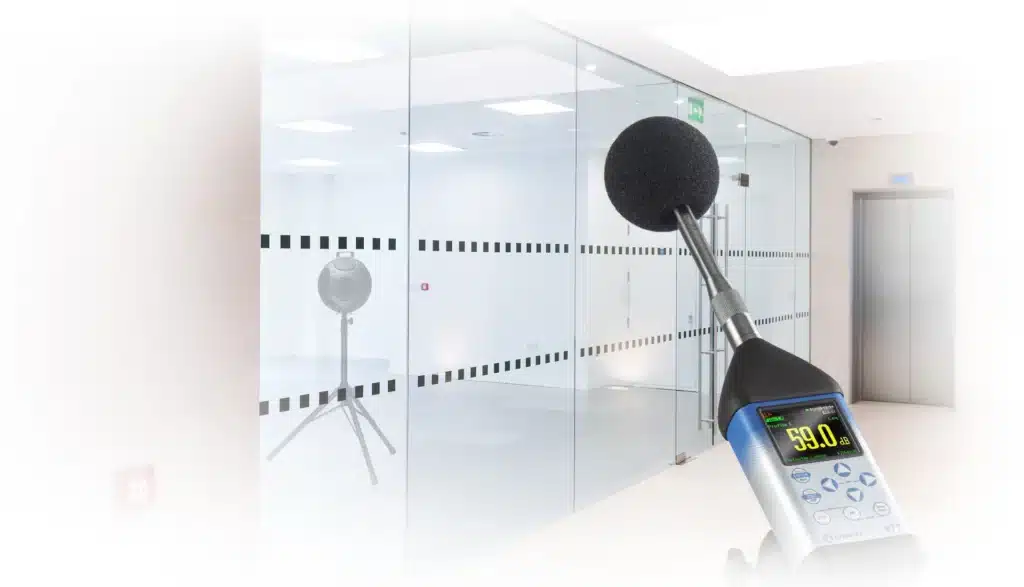
In the UK, internal noise levels are assessed under standardised conditions to ensure results are repeatable and representative of a building’s performance. Unlike environmental noise surveys, these internal measurements do not typically distinguish between daytime and nighttime periods; instead, they focus on the physical environment’s ability to attenuate sound. To achieve an accurate reading, all external windows and doors must be fully closed to isolate the internal space from outside interference. Furthermore, the room should be furnished as intended, as soft furnishings significantly influence sound absorption and the overall reverberation time of the space.
While the simplified survey method of BS EN ISO 10052 can be used for preliminary checks in smaller rooms (up to 150 m³), formal compliance often requires the more rigorous BS EN ISO 16283 engineering standard. The resulting noise level is heavily dictated by the acoustic integrity of the building’s “weakest links,” specifically the sound reduction index of windows, doors, and any penetrations in the partitions. If these elements fail to meet the performance standards set out in Approved Document E, the internal sound levels will exceed permissible limits, regardless of the quality of the primary wall or floor structures.
Survey Methods
The BS EN ISO 10052 standard defines simplified “survey-grade” methods for measuring airborne and impact sound insulation, alongside noise from building service equipment. Unlike detailed engineering-grade tests, these methods are designed for rapid screening and preliminary assessments rather than definitive compliance. The standard is specifically applicable to rooms in dwellings or spaces of a comparable size, generally limited to a volume of 150 m³ rather than a floor area of 150 m². It provides a repeatable framework for measuring sound levels using handheld instruments and manual microphone sweeping, which can then be converted into single-number ratings for comparison.
Engineering Measurement of Service Noise
The BS EN ISO 16032 standard defines a rigorous “engineering method” for measuring sound pressure levels produced by fixed service equipment within a building. It provides specific procedures for assessing noise from internal sources such as mechanical ventilation, heating and cooling systems, lifts, sanitary appliances, and motorised car park doors. Unlike the simplified survey methods of ISO 10052, this standard requires detailed measurements—often in one-third-octave bands—to account for factors like reverberation time and background noise. These methods are suitable for typical room volumes of approximately 300 m³ or less, covering most dwellings, offices, and schools. In the UK, this standard is an adopted national standard used by acoustic consultants and building services engineers to verify that equipment noise meets specified design targets. The latest 2024 update to the standard has recently been adopted by the BSI (British Standards Institution), ensuring that measurement techniques remain aligned with modern building technologies.
Methods for Measuring Partition Insulation
The sound insulation of a partition is assessed through two distinct environments: laboratory testing and field measurements.
- Laboratory tests are conducted under highly controlled conditions according to the BS EN ISO 10140 series. These tests measure the performance of a specific building element (like a door or a wall section) in isolation, free from external interference or structural flanking. The results provide a “Sound Reduction Index” RW, which manufacturers use to specify the acoustic potential of their products.
- Field measurements must be performed on-site following the BS EN ISO 16283 standards. These tests verify the actual performance of the partition as installed, accounting for real-world factors such as workmanship and “flanking” noise that travels around the partition via the building’s frame. The raw data from these field tests are then processed using the BS EN ISO 717 rating system to provide a single-number decibel value DnT,w, which determines if the building meets the mandatory requirements of Approved Document E.
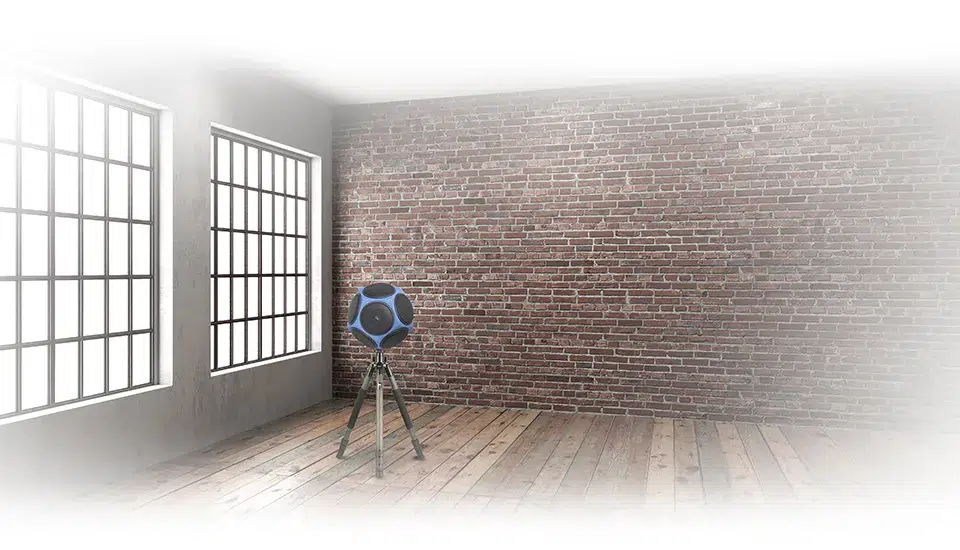
Standardised Acoustic Indicators
Acoustic performance is evaluated using weighted indicators that account for how the human ear perceives different frequencies. The weighted sound reduction index RW is the foundational laboratory-measured value, while apparent sound reduction indices R’ represent measurements taken in the field. To provide a more realistic assessment, these indices are often adjusted using spectral adaptation terms, C and Ctr, which are added to the RW value. The indicator RA1 (RW+C) assesses insulation against medium-to-high frequency noises like speech, music, or high-speed rail, using a “pink noise” spectrum. Conversely, RA2 (RW+Ctr) focuses on low-to-medium frequency sounds, such as urban road traffic or bass-heavy music, where Ctr acts as a correction for these more difficult-to-block frequencies.
For field-based assessments, the “prime” versions R’A1 and R’A2 are used to account for flanking transmission and other on-site installation variables, ensuring the finished structure remains compliant with national standards.
How should reverberation noise be determined?
The reverberation time is measured according to the BS EN ISO 3382 series, which distinguishes between performance spaces (Part 1) and ordinary rooms (Part 2). Measurements are typically taken in octave bands across a frequency range from 125 Hz to 4000 Hz (and occasionally up to 8000 Hz) to assess how different pitches decay within the space. To ensure accuracy and repeatability, tests are conducted in furnished but unoccupied rooms, as the presence of people significantly increases sound absorption and would artificially lower the results. Practitioners can choose between the engineering (technical) method, which uses a simplified number of microphone positions, or the precision method for more complex acoustic environments.
For certain building types, such as common areas in blocks of flats or specific school spaces, UK regulations allow for the assessment of minimum acoustic absorption as an alternative to measuring decay time. This involves calculating or testing the total area of sound-absorbing material (Class C or better) installed on the ceiling or walls, as prescribed in Approved Document E. Whether measuring time in seconds or calculating absorption in square metres, these methodologies ensure that internal spaces meet the “Requirement E4” standards for controlling reverberation and maintaining speech intelligibility.
Speech Intelligibility and the STI
Speech intelligibility defines how clearly and accurately verbal communication is understood within a specific internal environment. It is quantified using the Speech Transmission Index (STI), a numeric scale ranging from 0.0 (completely unintelligible) to 1.0 (perfect clarity). This parameter is essential for ensuring that spaces such as classrooms, lecture theatres, and courtrooms are fit for purpose, particularly for unamplified speech. The assessment, conducted according to BS EN 60268-16, evaluates how factors like background noise and reverberation time distort or “mask” the signal of a human voice.
Measurements are typically performed in furnished but unoccupied rooms to ensure a standardised testing environment. While a full STI analysis provides the most comprehensive data, the abbreviated STIPA (Speech Transmission Index for Public Address) method is frequently used in the UK for rapid on-site verification. To achieve a “Good” or “Excellent” rating—often required by Building Bulletin 93 (BB93) for educational settings—designers must carefully balance sound-absorbing materials to control echoes while maintaining low background noise levels from mechanical services.