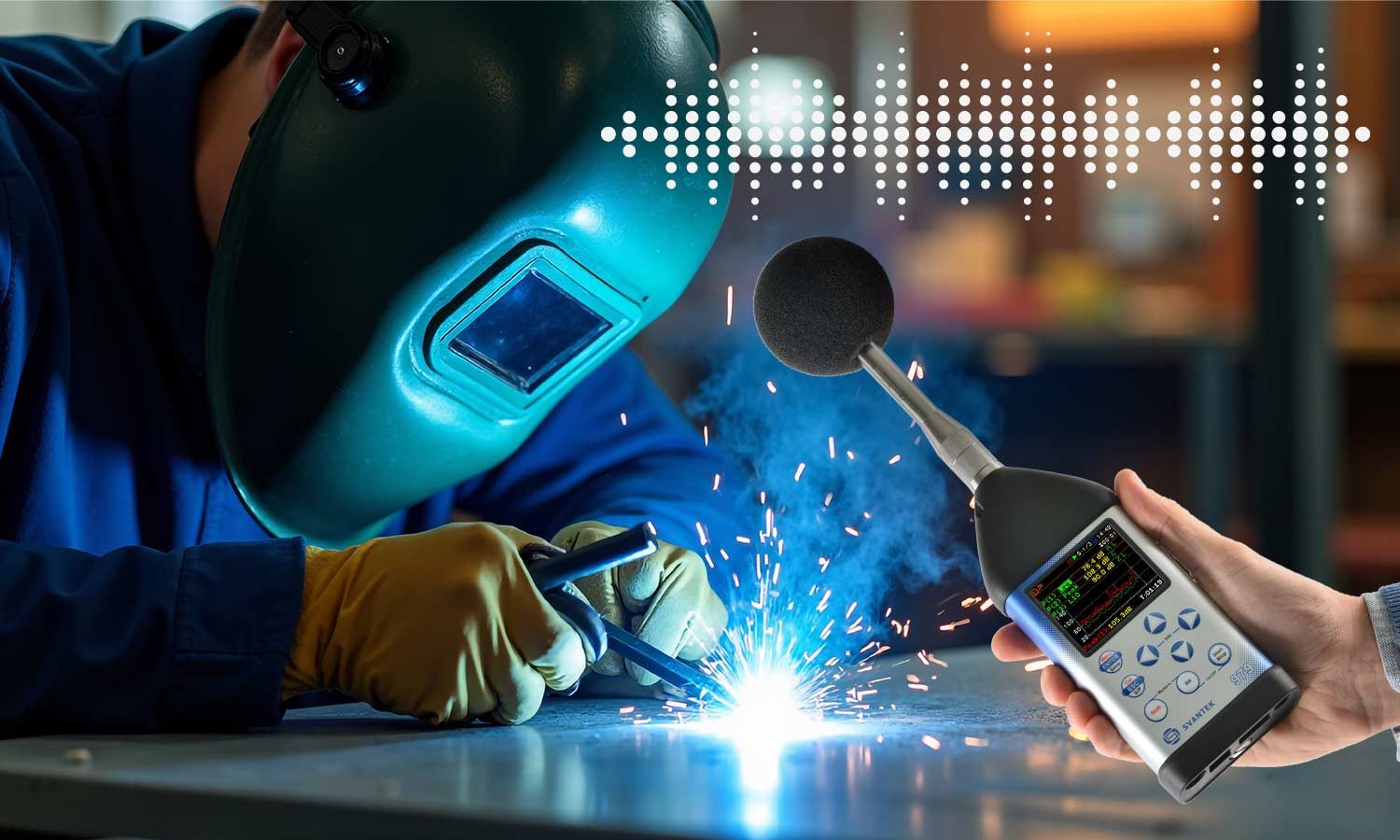
Ultrasonic noise at workplaces

Occupational ultrasonic noise exposure is an increasingly critical focus in industrial hygiene and workplace safety assessments. While audible noise is readily identified by its immediate perceived loudness and annoyance, ultrasound (frequencies typically above 20 kHz) is largely beyond the range of human hearing but can still induce significant physiological effects. Prolonged exposure to high-intensity ultrasound can lead to subjective symptoms such as dizziness, nausea, and fatigue, as well as potential thermal effects on biological tissues. Consequently, international safety frameworks, such as those from ACGIH (US) or ISO 1996/TR 25477, mandate that ultrasonic noise be subjected to the same rigorous risk assessment and mitigation strategies as conventional audible sound.

ultradzwieki

What is ultrasonic noise?

In acoustic engineering, ultrasound is technically defined as acoustic waves with frequencies exceeding the human hearing threshold of 20 kHz. However, for occupational health and safety (OHS) assessments, the measurement range is expanded to include high-frequency audible sound from 10 kHz to 40 kHz.

This extended range accounts for the fact that frequencies between 10 kHz and 20 kHz, while still audible to some individuals (particularly younger workers), share the propagation characteristics and physiological impacts of ultrasound, such as intense subjective fatigue and nausea. To ensure international technical precision, ultrasonic noise is analyzed in one-third octave bands across these center frequencies, allowing for a detailed spectral evaluation of specific industrial sources like ultrasonic welders, cleaners, or high-speed turbines.

How does ultrasound spread?

While the fundamental physics of wave propagation remain consistent across the acoustic spectrum, ultrasonic noise exhibits distinct behaviors due to its high frequency and short wavelengths. Specifically, ultrasound possesses strong directionality, behaving more like a beam of light than a diffuse sound source; this characteristic can lead to intense localized sound pressure levels through reflections and focusing.

Furthermore, ultrasound is subject to high rates of atmospheric attenuation, meaning its energy dissipates rapidly as it travels through the air. Consequently, the most significant occupational exposure is typically confined to the immediate near-field of the emission source, such as ultrasonic welders or cleaning baths. These factors necessitate precise, localized measurement strategies rather than the broad area monitoring used for lower-frequency audible noise.

Does ultrasound in the workplace pose a real threat?

In modern industry and medicine, ultrasound is used extensively for high-precision tasks such as cleaning, welding, and medical imaging. However, high-intensity occupational exposure to airborne or contact ultrasound can lead to significant adverse health effects, including subjective symptoms like nausea, dizziness, fatigue, and headaches, as well as physiological risks such as cavitation-induced tissue heating. To manage these hazards, international standards from organizations like the American Conference of Governmental Industrial Hygienists (ACGIH) and NIOSH recommend establishing permissible exposure limits (PELs) and conducting regular acoustic monitoring to prevent both acute symptoms and long-term hearing impairment.

Effective protection for workers follows a hierarchy of controls, prioritizing engineering solutions such as sound-absorbing enclosures, barriers, and specialized shielding to block highly directional ultrasonic beams. If noise levels remain above statutory thresholds, administrative controls—including worker rotation and restricted access to high-power zones—must be implemented, alongside the mandatory use of specialized Personal Protective Equipment (PPE) like high-frequency rated earplugs or earmuffs. Furthermore, because contact ultrasound (e.g., during ultrasonic cleaning) is significantly more hazardous than airborne exposure, strict protocols must be enforced to prevent accidental skin contact with active transducers or energized biological tissues.

Why is ultrasonic noise dangerous to humans?

In addition to auditory risks, occupational ultrasonic noise can impact the human body through both airborne transmission and direct physical contact with vibrating sources. High-intensity airborne ultrasound is primarily absorbed by the skin and the hearing organ, frequently resulting in subjective symptoms such as persistent fatigue, headaches, nausea, and tinnitus. Because these high-frequency waves have short wavelengths, they can also cause localized thermal effects in soft tissues and are associated with disturbances in the autonomic nervous system, leading to dizziness and equilibrium imbalances even when the sound is not consciously “heard.”

While the risk of permanent noise-induced hearing loss (NIHL) is lower for ultrasound than for audible sound, the cumulative physiological strain remains a significant concern in industrial hygiene. International bodies like the ACGIH and World Health Organization (WHO) emphasize that exposure to high-pressure levels in the 20 kHz to 40 kHz range can lead to “ultrasonic sickness,” a syndrome characterized by a decline in coordination and cognitive performance. Consequently, protective measures must account for both the atmospheric propagation affecting the ears and the potential for structural vibration to be conducted through the skeletal system.

How to protect employees from ultrasonic noise?

To mitigate occupational exposure to ultrasonic noise, the hierarchy of controls prioritizes engineering solutions, such as acoustic enclosures and sound-absorbing shields, to contain highly directional high-frequency waves. When direct machine operation prevents total containment, personal protective equipment (PPE)—specifically high-frequency rated earplugs or earmuffs—must be used, alongside administrative controls like worker rotation to limit cumulative daily exposure. Furthermore, modern equipment design focuses on source reduction, where manufacturers utilize specialized damping materials and precision-engineered transducers to minimize parasitic ultrasonic emissions into the ambient environment.

  • Engineering Controls: The use of transparent acoustic shields (e.g., acrylic or polycarbonate) is highly effective against ultrasound because its short wavelength is easily reflected and attenuated by solid barriers.
  • Source Mitigation: International standards like ISO 11688-1 provide a framework for designing low-noise machinery, emphasizing that reducing vibration at the transducer or motor level is the most effective long-term solution. 
  • PPE Selection: Standard hearing protection may have variable attenuation at ultrasonic frequencies; therefore, equipment must be verified against the specific one-third octave band profile of the workplace (e.g., 20 kHz to 40 kHz).


Ultrasonic noise - regulations

Occupational exposure to ultrasonic noise is governed by national health and safety frameworks that define permissible sound pressure levels across high-frequency bands, typically ranging from 10 kHz to 40 kHz. In Poland, the Regulation of the Minister of Family, Labor and Social Policy (2018) establishes strict Maximum Admissible Intensities (MAI), with special protections for pregnant women and adolescents under the 2017 Council of Ministers decree. Similarly, Germany utilizes VDI 3766 to provide mandatory assessment procedures once frequencies exceed 16 kHz. While the United Kingdom manages these risks under the Control of Noise at Work Regulations 2005 via HSE technical guidance, the United States relies on the ACGIH Threshold Limit Values (TLVs), which are globally recognized benchmarks for preventing non-auditory effects like nausea and dizziness.

To ensure international compliance and worker safety, specialized measurement and mitigation protocols must be implemented by accredited laboratories. These assessments focus on one-third octave band analysis to identify specific industrial emission peaks from equipment such as ultrasonic welders or cleaning baths. Because ultrasound is highly directional and attenuates rapidly in the air, the primary risk is concentrated in the immediate near-field of the source. Mitigation strategies follow a strict hierarchy, prioritizing high-density acoustic shielding and source reduction over secondary measures like administrative rotation or specialized high-frequency personal protective equipment (PPE).

How to measure ultrasound?

Measuring ultrasonic noise in the workplace requires specialized high-frequency instrumentation and specific spectral analysis, as standardized audible noise indicators (like LAeq) are insufficient for the 10–40 kHz range. Across the US, UK, Germany, and Poland, measurements primarily focus on identifying sound pressure levels within one-third octave bands to detect hazardous peaks and calculate cumulative daily exposure.

The measurement process relies on two critical acoustic indicators to determine if a workplace meets safety standards. If any single frequency band exceeds the predefined limit, the employer is legally or ethically required to implement noise reduction measures.

  • Equivalent Sound Pressure Level (Leq): This measures the energy-averaged sound level in each one-third octave band (from 10 kHz to 40 kHz), typically normalized to an 8-hour working day
  • Maximum Sound Pressure Level (LFmax): This captures the highest instantaneous sound pressure level in the same frequency bands to identify short-term high-intensity bursts that can cause acute subjective symptoms.

Permissible levels of ultrasonic noise at the workplace in Poland

The permissible levels set in the regulation depend on the frequency. Equivalent levels should not exceed 80 dB for frequencies 10, 12.5, 16 kHz, not exceed 90 dB for 20 kHz, not exceed 105 dB for 25 kHz and not exceed 110 dB for 31.5 and 40 kHz. In turn, the permissible maximum levels are 100 dB, 110 dB, 125 dB and 130 dB for the highest frequency group, respectively. These values ​​are summarized in the table below.

Frequency[kHz]Equivalent sound pressure level[dB]Maximum sound pressure level[dB]
10, 12.5, 1680100
2090110
25105125
31.5, 40110130

Request a Quote for Class 1 Noise & Vibration Monitoring Systems


    Please indicate the subject of your enquiry:

    I hereby consent to the processing of my personal data, i.e. my full name and e-mail address, by SVANTEK SP. Z O.O. with its registered office in Warsaw at ul. Strzygłowska 81 for the purpose of receiving marketing information on the products and services offered by SVANTEK SP. Z O.O. via electronic means of communication, in particular via e-mail, in accordance with the provisions of Article 10 sec. 1 and 2 of the Act on providing services by electronic means.

    I hereby consent to the processing of my personal data, i.e. my full name and phone number, by SVANTEK SP. Z O.O. with its registered office in Warsaw at ul. Strzygłowska 81 for the purpose of marketing activities with the use of telecommunications terminal equipment and automatic calling machines within the meaning of the Telecommunications Act.

    I hereby consent to receiving from SVANTEK SP. Z O.O. with its registered office in Warsaw at ul. Strzygłowska 81, via electronic means to the e-mail address I have provided, the newsletter and marketing information on the products and services offered by SVANTEK SP. Z O.O., within the meaning of the Act on providing services by electronic means.


    I declare that I have been informed that my data may be transferred to entities that process personal data on behalf of the Administrator, in particular to distributors - such entities process data on the basis of an agreement with the Administrator and exclusively in accordance with its instructions. In such cases, the Administrator requires third parties to maintain the confidentiality and security of information and verifies that they provide appropriate measures to protect personal data.

    Some of the entities processing personal data on behalf of the Administrator are established outside the EEA. In connection with the transfer of your data outside the EEA, the Administrator verifies that these entities provide guarantees of a high level of personal data protection. These guarantees stem in particular from the obligation to apply the standard contractual clauses adopted by the Commission (EU). You have the right to request a copy of the standard contractual clauses by sending a request to the Controller.

    I declare that I have been informed on my right to withdraw my consent to the processing of my personal data at any time, to access the provided personal data, to rectify, erase, restrict processing and object to the processing of my data, as well as the right to lodge a complaint with the President of the of the Personal Data Protection Office in the event of an infringement of the provisions of GDPR.