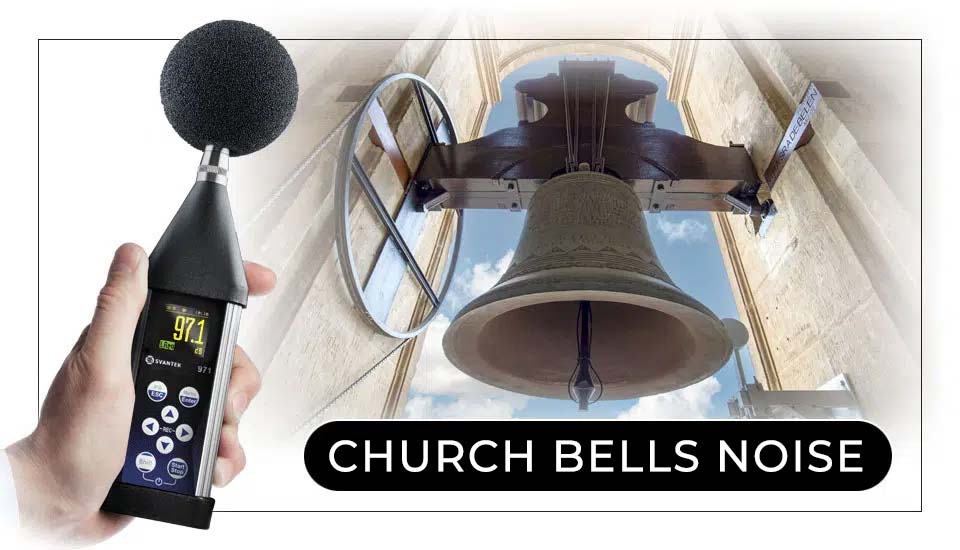
Church bell noise is classified as an impulsive, irregular sound generated when the clapper strikes the bell’s soundbow, often reaching intensities between 110 dB and 125 dB within the immediate vicinity of the tower. Designed to broadcast over long distances, these sounds can cause significant disturbance to nearby residents, particularly during frequent services or extended celebrations. In the UK, such noise is evaluated as an impulse sound under acoustic standards like BS 4142, which accounts for the specific character and “nuisance” factor of the strike when determining if the noise levels constitute a statutory nuisance.
Church bell noise regulation is primarily managed through local, national, or regional laws rather than overarching international standards, balancing religious expression with community noise concerns. In the United States, courts may apply time, place, and manner restrictions on bell ringing to mitigate nuisances, while European Union countries, such as Poland, often handle these matters via national regulations, sometimes classifying bells as exempt “natural noise” or as localized nuisances, depending on the intensity.
In the UK, these activities must still comply with the Environmental Protection Act 1990. Local authorities have a statutory duty to investigate complaints and can issue abatement notices if the noise is deemed a statutory nuisance—defined as an unreasonable and substantial interference with the use or enjoyment of a home. Courts typically balance the tradition of the “established church” against modern residents’ rights, often considering factors like the duration, frequency, and time of day. Furthermore, the UK planning policy now requires developers of new housing near existing churches to mitigate potential noise issues, protecting historic bells from new residents’ complaints.
If church bell noise is causing a disturbance, the initial step is to seek an amicable resolution by contacting the parish priest, who jointly control the ringing. Many churches are willing to compromise by adjusting ringing times, durations, or using muffles—leather caps placed on the bell clappers—to dampen the sound.
If direct dialogue fails, residents can report a statutory nuisance to the local council’s environmental health department. Under the Environmental Protection Act 1990, councils must investigate and can issue an abatement notice if the noise is deemed an unreasonable interference with property enjoyment. This process distinguishes between natural bells, which are often protected by custom, and electronic sound systems, which are more strictly regulated as noise emissions.